
Why should a train you may never ride matter to your casino trip?
Because the single biggest variable in a casino destination’s health is how easily people can get there, and right now the most ambitious piece of new Vegas casino tourism infrastructure is sitting very still. Brightline Holdings and roughly 16 affiliated Florida companies have filed for Chapter 11 bankruptcy protection in New Jersey, entering a restructuring support agreement with existing investors who will put a further $490 million into the Miami-to-Orlando railroad. Brightline Trains Florida, the entity that actually runs those trains, did not file, and service there continues.
Brightline West, the company that still says it will build a 200 mph line from Las Vegas Boulevard to Southern California, is a separate legal entity with overlapping ownership rather than a wholly owned subsidiary of the Florida railroad. A spokesperson told the Las Vegas Review-Journal that the Florida bankruptcy “has no bearing” on the Vegas project and that the focus “remains on completing the financing.” Legally, that distinction holds. Practically, the Vegas project has shown no visible progress for a long time.
The problem: Las Vegas visitor access has one obvious weak point
Las Vegas is unusual among gaming destinations because it depends on two very different arrival channels. Flights bring in the long-haul and international crowd. Everyone else drives, and an enormous share of that drive market comes up Interstate 15 from Southern California, a corridor that turns into a parking lot every Sunday afternoon.
That’s the gap Brightline West was built to fill: a 218-mile line in the I-15 median, Las Vegas Boulevard to Rancho Cucamonga in about two hours, with a Metrolink transfer onward to Los Angeles. For resort operators, that isn’t a transport curiosity. It’s a mechanism for converting a tiring four-to-five-hour drive into a two-hour ride, which tends to shorten the decision window for a weekend trip and widen the pool of people willing to make one. Shorter friction, more visits. That’s the whole thesis behind casino resort economics in a drive-in market.
Take the train away and nothing breaks. Vegas has survived decades on cars and planes. But the growth story that operators, Clark County and the Nevada tourism apparatus have been quietly planning around gets pushed out by years, and so does any expansion in airport and hotel capacity that assumed a rail feeder.
Brightline West at a glance
| Item | Detail |
|---|---|
| Route | Las Vegas Boulevard (between Blue Diamond and Warm Springs roads) to Rancho Cucamonga, California |
| Length and alignment | 218 miles, in the Interstate 15 median |
| Top speed / trip time | Up to 200 mph / about two hours |
| Intermediate stops | Hesperia and Victor Valley, plus a possible station at the Southern Nevada Supplemental Airport near Jean, Nevada |
| Los Angeles connection | Metrolink transfer at Rancho Cucamonga |
| Ceremonial groundbreaking | April 2024 |
| Cost estimate | Roughly $12.4 billion, revised to $21.05 billion per federal project documents and later reporting |
| Federal support | $3 billion federal grant |
| Original target | In time for the 2028 Los Angeles Olympic Games |
| Current target | Late 2029 |
What’s actually driving the delay
Three things, and only one of them is the bankruptcy.
The price moved, badly. After the April 2024 ceremonial groundbreaking, the estimated cost nearly doubled, from about $12.4 billion to $21.05 billion. A $3 billion federal grant covers a meaningful slice of the original number and a much thinner slice of the new one. Everything above that has to come from private capital, and private capital prices risk by looking at the sponsor’s balance sheet.
The sponsor’s credibility took a hit. Fortress-backed Brightline inherited the old XpressWest plan in 2018 and rebranded it Brightline West in 2020. The Florida business is the proof-of-concept that investors were asked to extrapolate from. When that business needs $490 million of rescue money and a Chapter 11 filing to reorganise, the cost of financing a far larger, unbuilt desert line goes up, regardless of how the corporate entities are separated on paper.
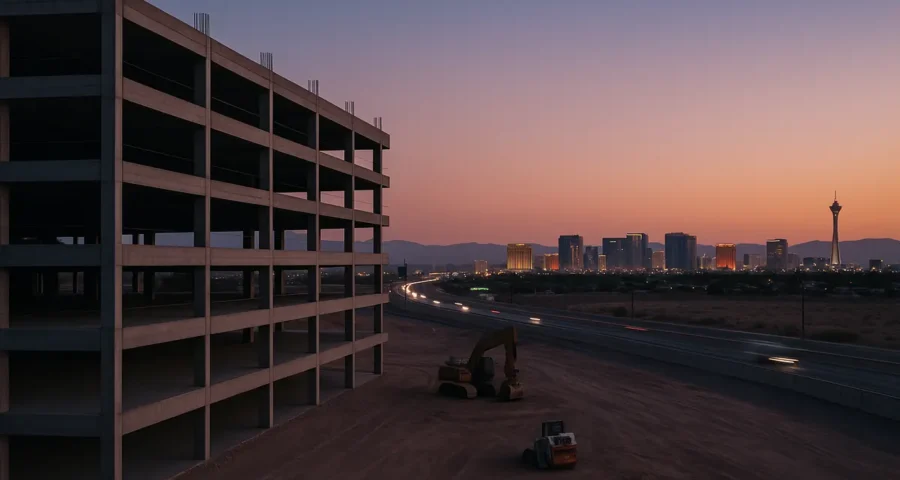
The site has gone quiet. Early work on the roughly 110-acre Las Vegas terminus started in 2025 with grading, sewer and storm-drain work, and the beginnings of a parking garage. Crews have not been seen at that garage for at least six months, and no new construction phase has been announced. Heavy construction, the part that matters, laying track in the I-15 median across the Mojave, has not begun. The 2028 Olympics deadline was already gone before the Florida filing. Late 2029 is the stated target now, and nothing visible on the ground supports it.
What it means in practice for gaming tourism trends
If you follow casino stocks, operator earnings calls or simply plan your own trips, here is the honest read.
- No near-term change to Vegas access. Visitation in 2026 through 2029 will be shaped by airlines, room rates, resort fees and the I-15 drive, not by rail. Any model that priced in rail-driven visitor growth before 2030 should be rewritten.
- Casino destination travel remains the lever operators can’t control. Resorts can discount rooms and add shows. They cannot add highway lanes. That asymmetry is why Strip operators have been vocal supporters of both the rail line and the proposed Southern Nevada Supplemental Airport, which Clark County hopes to open between 2035 and 2037.
- Weekend compression stays the norm. Without a two-hour alternative, Southern California demand keeps clustering into Friday-to-Sunday patterns, which keeps midweek occupancy soft and midweek promotions aggressive. That’s genuinely useful if you’re booking a trip.
- Online play keeps absorbing marginal demand. When travel friction stays high, some share of play simply happens at home. Nevada itself allows regulated online poker and mobile sports betting but not online casino games, so the substitution shows up mostly in other states’ regulated markets and in the global offshore and crypto-casino sector rather than in Nevada’s own online numbers.
- The money is still real. A $3 billion federal grant and a restructuring agreement funded by existing investors are not signs of abandonment. They’re signs of a project that needs a financing close before it needs a construction crew.
How to read infrastructure news like an analyst instead of a headline
Megaproject press releases are optimistic by design. If you want to judge whether the Brightline Vegas rail line is genuinely moving, watch for the things that cost money rather than the things that cost nothing.
- Financing close, not financing “progress.” A signed debt package with named investors is the milestone. “Focus remains on completing the financing” is not.
- Track work in the I-15 median. Grading a parking lot is site prep. Laying rail across the Mojave is the project.
- Activity at the Las Vegas terminus. Idle equipment and an unannounced next phase is the clearest signal available, and it’s one anyone driving past can check.
- Federal grant conditions and deadlines. Grants of that scale come with milestone requirements. Changes to them tell you more than any statement.
- Operator commentary. If Strip operators stop referencing the line in capital-planning language, they’ve already repriced it.
Apply the same filter to any casino-adjacent build, whether that’s a resort in Japan, a New York downstate licence or a rail line in Nevada. Groundbreakings are cheap. Cost estimates that double are the tell.
FAQ
Does Brightline’s bankruptcy cancel the Las Vegas project?
No. Brightline West is a separate legal entity with overlapping ownership, and the company says the Florida filing “has no bearing” on the Vegas line. But the Vegas project still needs to close billions in private financing, and a sponsor in Chapter 11 makes that harder.
When would the Vegas to Southern California train open?
The stated target is late 2029, after the original goal of being ready for the 2028 Los Angeles Olympics slipped away. Heavy construction has not started, so treat that date as aspirational.
How do most people reach Las Vegas casinos today?
By air through Harry Reid International Airport, or by car, with a very large share of drive-in visitors arriving from Southern California on Interstate 15. That mix stays unchanged for the rest of this decade.
Would the rail line change how much casinos earn?
It would change how many people arrive and how often, which is the input that matters most in a drive-in market. Nobody can put a reliable revenue figure on a line that hasn’t been built, and anyone who quotes one is guessing.
One last thing worth saying plainly: easier access to a casino destination doesn’t improve anyone’s odds once they’re inside. Every game carries a built-in house edge, so set a budget and a time limit before you travel, and use deposit and loss limits when you play online. If gambling stops being entertainment, support services are available in most jurisdictions.
Leave a Reply