
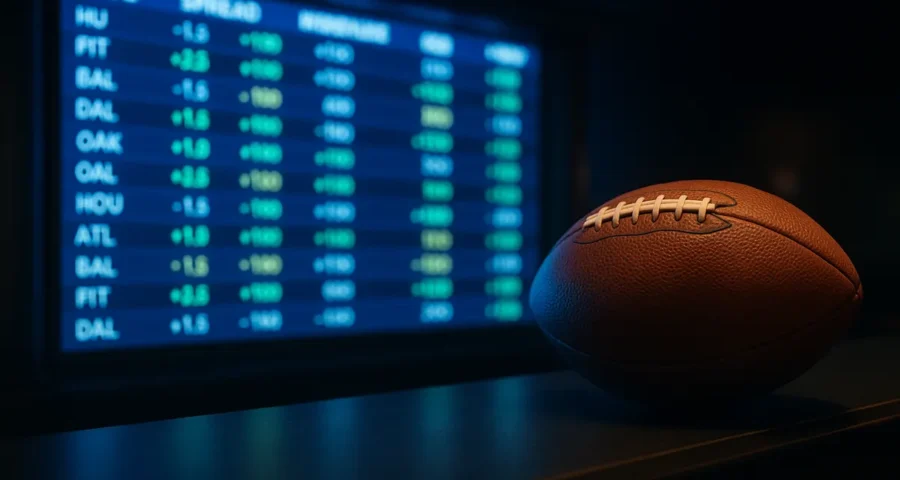
Why did five NFL favourites lose in a single weekend?
Because a point spread is an opinion with a price on it, not a prediction of what will happen. That is the one idea worth taking away from Week 3, and it explains almost everything you will read about NFL underdog betting odds from here on.
Look at what the board got wrong. The Seattle Seahawks (-8.5), Green Bay Packers (-4.5), Philadelphia Eagles (-3.5), Cincinnati Bengals (-2.5) and Carolina Panthers (-1.5) all lost outright. The San Francisco 49ers and Detroit Lions both won and still failed to cover -7.5. Backup quarterbacks went 7-3 straight up across the season to that point, and Caesars Sportsbook trading VP Craig Mucklow was blunt about where the mistake sat: “The Eagles drew heavy support in a perceived No. 1 versus No. 3 quarterback mismatch, but with backups now 7-3 straight up, the bigger mistake has been in the original numbers, not the betting that followed.”
That is a bookmaker admitting the opening line was off. Useful to know if you are new to American football and assuming the number handed to you is gospel.
How NFL point spreads work
What a point spread actually represents
A point spread is a handicap applied to the stronger team so that betting either side is roughly a coin flip. If the Bears are +3.5 against the Eagles, the Bears start the bet with 3.5 points added to their final score. Eagles backers need Philadelphia to win by 4 or more. Bears backers win if Chicago wins outright or loses by 3 or fewer.
In Week 3 that bet was not close. Chicago, a 3.5-point underdog, won 27-7. If you think of it in cricket or football terms, it is the same logic as an Asian handicap: the market is pricing the expected margin, not the winner.
Reading plus and minus numbers
Minus means favourite, plus means underdog. Simple as that.
- Lions -7.5 means Detroit must win by 8 or more for the bet to cover.
- Jets +7.5 means New York can lose by 7 and the bet still wins.
- The half point exists to remove ties. A whole number like -7 can produce a push, where the game lands exactly on the spread and your stake is returned.
Both sides of a spread are usually priced near 1.91 in decimal odds (-110 in American format). That extra bit built into the price is the sportsbook’s margin. Win half your spread bets at 1.91 and you lose money slowly. That is the house edge in action, and no amount of handicapping removes it.
Why backup quarterbacks move betting lines
The QB impact factor
No position in team sport carries the pricing weight of an NFL quarterback. A starter going down can move a spread several points in minutes, because the quarterback touches every offensive snap. Oddsmakers do not just downgrade the team’s talent, they downgrade the predictability of the offence.
Week 3 showed how roughly that gets priced. Chicago was without both Caleb Williams and Tyson Bagent and handed the ball to 38-year-old Case Keenum, who had not started a game since 2023 with Houston. He went 24-of-34 for 247 yards and two touchdowns in a 27-7 win over Philadelphia. Washington, with Marcus Mariota starting, beat the defending champion Seahawks 33-31. Minnesota went 2-0 with Carson Wentz. Seattle had gone 2-0 with Drew Lock while Sam Darnold was injured. The New York Giants won a game with Jameis Winston. Atlanta, with Cooper Rush, went 0-2.
So backups are not magic. The record was 7-3, not 10-0, and Mucklow’s own verdict on the Bears result was “sometimes it’s better to be lucky than good.” The pattern is subtler than “bet every backup”: the market was shading these teams further than the drop in actual performance justified.
How sportsbooks price uncertainty
When a book has no recent sample on a quarterback, it does two things. It widens the spread to protect against a collapse, and it watches where the money goes. Public bettors pile onto the recognisable starter in a “No. 1 versus No. 3” matchup, which pushes the number further still. By kickoff you can have a spread built on reputation rather than on a defence that has been playing well, a strong run game, or a home crowd at Soldier Field.
That gap between perceived mismatch and actual mismatch is where underdog prices get interesting. It is also why injury news is the single most valuable information in NFL betting, and why lines released early in the week can look nothing like Sunday’s closing number.
What happens to the odds after an upset
Correction versus overreaction
Markets adjust after results, and they rarely adjust by exactly the right amount. A genuine correction is new information being absorbed: the backup can actually play, the favourite’s offensive line is a problem, a defence is better than its reputation. An overreaction is one game being treated as a trend.
Here is how Week 3 looked on the board:
| Favourite (spread) | Result | Outcome for favourite backers |
|---|---|---|
| Seahawks -8.5 | Lost 31-33 to Commanders | Lost outright |
| Packers -4.5 | Lost 14-35 to Falcons (+4.5) | Lost outright |
| Eagles -3.5 | Lost 7-27 to Bears | Lost outright |
| Bengals -2.5 | Lost to Steelers | Lost outright |
| Panthers -1.5 | Lost to Panthers’ opponent, Browns | Lost outright |
| 49ers -7.5 | Won 36-30 vs Cardinals | Won, did not cover |
| Lions -7.5 | Won 31-24 vs Jets | Won, did not cover |
Note the bottom two rows, because they catch out every newcomer. Backing a team to win and backing it to cover are different bets with different outcomes.
The ripple effect into next week
After a result like Chicago’s, three things typically happen. The winner’s next spread tightens. The loser gets quietly downgraded in power ratings. And casual money starts chasing the team it just watched on primetime television. Caesars’ head of football Joey Feazel framed exactly that question about Cleveland after its win over Carolina, wondering “whether that result earns Cleveland any support from bettors when the Browns return to primetime.”
Recency bias is real, it is measurable in line movement, and it is the reason yesterday’s hero is often tomorrow’s overpriced favourite.
Where value actually comes from
Identifying an undervalued underdog
Value in betting means one thing: the price implies a lower probability than you believe is true. Nothing more romantic than that. Convert the odds first. Divide 1 by the decimal price to get implied probability, so 2.50 implies 40% and 3.00 implies 33.3%. If your own read says a +170 (2.70) underdog wins closer to four times in ten rather than three, that is a value case. If you cannot articulate why, you are guessing.
Questions worth asking before you back a dog:
- Is the spread built on last year’s reputation or this season’s form?
- Does the underdog’s strength (run defence, pass rush, time of possession) attack the favourite’s weakness?
- Has heavy public money on the favourite inflated the number beyond the true gap?
- Is the backup quarterback being asked to manage a game, or to win it alone?
Managing risk when you back underdogs
Underdog betting is high variance by design. You lose more bets than you win and depend on bigger returns to balance it, which feels uncomfortable for weeks at a stretch. A flat staking plan, one consistent small unit per bet, keeps a cold run from becoming a disaster. Chasing a losing week with double stakes is how most newcomers run out of money.
And be honest about the maths: the bookmaker’s margin sits in every price, so there is no selection method that turns betting into reliable income. Set a deposit limit, treat the money as entertainment spend, and use the responsible gambling tools your operator provides if it stops being fun.
Reading the whole board, not just the spread
Moneyline, spread and totals
The moneyline is a straight bet on who wins, with no handicap. A 3.5-point underdog carries a longer moneyline price precisely because winning outright is harder than covering. Chicago backers who took the moneyline rather than +3.5 were paid considerably more for the same 27-7 result.
Totals (over/under) price the combined score of both teams and move on weather, pace and injuries rather than on who wins. Week 3’s late afternoon slate was, in Feazel’s words, “an Over bettor’s dream, with points piling up and Totals cashing across the board” and a late field goal in the 49ers-Cardinals game decided both the Arizona cover and several totals. One game, several independent markets.
Timing and line shopping
Numbers move all week. Early lines carry more error and more opportunity, but also more risk that news breaks against you. Closing lines are sharper because all the money and information is in. Practical habits that help more than any prediction:
- Compare the same game across multiple licensed sportsbooks. Half a point of spread or a few cents of price changes your long-run results more than you would expect.
- Track injury reports through the week, not just on game day.
- If you like an underdog, taking the points early often gets the better number before the market corrects.
- Remember the clock. Sunday’s 1pm ET kickoffs land around 10:30pm IST, and Monday night games fall in the early hours, so set your bets while you are clear headed rather than half asleep.
Quick answers
How do NFL point spreads work?
The favourite is handicapped by a number of points. Subtract that margin from its final score to settle the bet. A -3.5 favourite must win by 4 or more; the +3.5 underdog covers by winning or losing by 3 or fewer.
Why do backup quarterbacks affect betting odds so much?
The quarterback is involved in every offensive play, so losing a starter changes both expected performance and the reliability of the projection. Books widen the spread to cover that uncertainty, and public money on the recognisable starter widens it further.
What makes an underdog bet valuable?
Only a mismatch between the implied probability in the price and the probability you can justify from form, matchups and situation. Big odds alone are not value.
How do I read NFL betting lines as a beginner?
Start with three numbers per game: the spread, the moneyline and the total. Convert prices to implied probability, check whether your book shows American or decimal odds, and confirm whether a result needs an outright win or just a cover.
Week 3 was not proof that underdogs win. It was proof that opening numbers are estimates made under uncertainty, sometimes wrong, and always carrying a margin for the house. Betting with that in mind is the actual skill. Must be 18+ (or the legal age where you live) to gamble.
Leave a Reply