
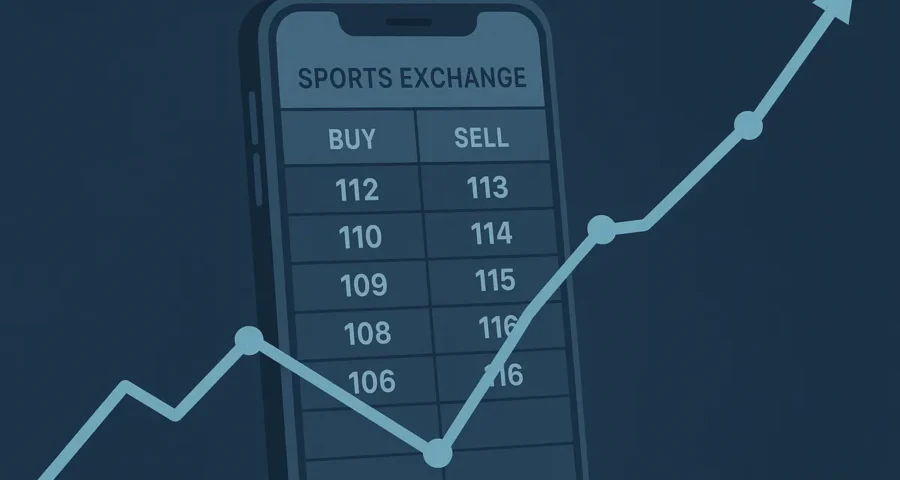
Picture the last over of a tight T20 match. A price on a sports exchange ticks from 62 to 71 while you are still deciding. No odds compiler moved it. Another user did, by taking the other side of the trade at a better number than you were willing to accept.
That mechanic is the reason a sports-only exchange called Novig has just been handed one of the loudest numbers of the year. A betting startup valuation of $2 billion, reported by multiple outlets citing people familiar with the financing round, for a company that was valued at $500 million in its Series B barely seven and a half months earlier. Four times the price in under eight months. Worth understanding what investors think they are buying.
What is Novig, and why did it reach a $2 billion valuation?
Novig is a sports prediction market: a peer-to-peer exchange where users buy and sell yes/no contracts on sporting outcomes instead of taking fixed odds from a bookmaker. It reached a reported $2 billion valuation because it got regulatory permission to operate at national scale in the United States, and because its trading volume grew fast enough to make that permission look valuable.
A sports-only exchange, not a sportsbook
On a traditional sportsbook, the operator is your counterparty. It prices the market, accepts your stake, and keeps the margin built into the odds. On Novig, you are matched against another user. The platform runs the marketplace rather than the risk book, which is a fundamentally different business: lower exposure to bad results, more dependence on volume.
The legal structure matters as much as the mechanics. In June, the Commodity Futures Trading Commission granted Novig Designated Contract Market status, the approval needed to run a regulated prediction market in the US. That let the exchange operate in nearly all 50 states, sidestepping the state-by-state licensing grind that traditional sportsbooks have to complete one jurisdiction at a time. Novig is currently live in 47 states, with Arizona, Michigan and Nevada the exceptions.
The numbers behind the valuation
According to the company’s own website, more than 250,000 traders have driven $6.5 billion of volume on the platform. The Series B round raised $75 million at a $500 million valuation, led by Pantera Capital, with Forerunner, NFX and Perceptive Ventures joined by Edge Equity, Makers Fund and Multicoin Capital. Reports suggest investor appetite jumped sharply after the DCM approval landed.
Context keeps it honest. At $2 billion, Novig is still a small player: the two largest prediction market operators are reported to be worth roughly $60 billion between them. The company has announced no IPO plans. There is also a quirky footnote that generated most of the mainstream coverage. Actress Sydney Sweeney, who fronts Novig’s much-criticised ad campaign, took equity instead of a standard cash fee. Nobody has disclosed the size of her stake, but even half a percent would be $10 million at this valuation.
What drives betting platform valuations this high?
Three things, roughly in this order: regulatory access, unit economics, and the market the platform can plausibly reach.
Regulatory clarity is the biggest single lever
Novig’s valuation quadrupled after an approval, not after a product launch. That tells you where the value sits. A licence or exchange designation converts a product into a distribution footprint. Venture capital will pay a large multiple for a company that has moved from “legally uncertain in most places” to “operational almost everywhere”, because the hardest risk has been priced out.
Technology, fintech plumbing and user experience
Modern betting platforms are fintech businesses wearing sports jerseys. Order matching, real time settlement, fraud screening, instant payouts, KYC checks that clear in minutes rather than days. None of that is glamorous, and all of it decides whether a user funds an account or abandons it. Investors read fast, clean money movement as a moat, because rebuilding it is expensive and slow.
Market size and the cost of a customer
User acquisition is the industry’s largest line item. Any model that lowers it, by word of mouth, by a product people actually prefer, or by a celebrity equity deal that swaps cash spend for dilution, improves the maths. The Sweeney arrangement is a neat illustration: marketing paid for with stock instead of burn.
Market size then does the rest of the work. A sports-only exchange with national US reach has a large addressable base, and the same logic is why investors keep looking at India, where cricket engagement is enormous. The catch for Indian readers is that reach and legality are different questions. India’s rules on real-money online betting have tightened and still vary in interpretation across states, so a platform’s availability here says nothing about whether using it is lawful for you. Check that first, not last.
How does peer-to-peer betting work?
You post an order at the price you want, or you take an order someone else has posted. If a counterparty matches you, the position is live. The exchange holds the funds, settles the result, and takes a commission. No bookmaker sets the number; the market does.
| Feature | Traditional sportsbook | Peer-to-peer exchange / prediction market |
|---|---|---|
| Who sets the price | Operator’s models and odds compilers | Users’ buy and sell orders |
| Your counterparty | The operator | Another user |
| How the platform earns | Margin built into the odds (the overround) | Commission or fee on trades |
| Liquidity | Operator-backed, up to its own limits | Depends on how many users are trading that market |
| Niche markets | Usually offered, often with wider margin | Can be thin or unmatched |
| Exiting early | Only if a cash out tool is offered | Often possible by trading out at the current price |
What bettors gain, and what they don’t
The genuine advantages are transparency and pricing pressure. Because users compete to fill each other’s orders, the spread between the two sides of a market is usually narrower than a bookmaker’s overround, and you can see the depth behind a price. Being able to trade out of a position mid-event is a real feature, not a marketing one.
What it does not do is remove the cost of betting. Commission is still a cost, and on an exchange you are up against other users, some of whom are better informed, faster and better capitalised than you. A smaller margin changes the size of the drag, not the direction of it. Over time, most participants lose money, and no model, exchange or sportsbook, changes that.
Why investors back the model
Exchanges scale on volume rather than on winning against customers. There is no bad weekend when favourites all land, no need to limit sharp accounts to protect a risk book, and revenue is more predictable. That profile reads like a trading venue, and trading venues command higher multiples than bookmakers.
What does a big valuation actually change for users?
Capital shows up in the product within a year or two, usually in three places.
- Features and speed. Funded platforms ship faster: better charts, order types, cash-out logic, live data, cleaner apps. Weakly funded ones ship bug fixes.
- Pricing and liquidity. On an exchange, liquidity is the product. More users means tighter spreads and larger orders filled without moving the price. Thin markets are where exchange models disappoint.
- Compliance and safety. Regulated status brings audits, segregated funds, identity verification and mandatory responsible gambling tools. It makes onboarding slower and the platform considerably more accountable if something goes wrong.
The trade-off rarely gets mentioned in funding coverage: money raised at a high valuation has to be returned, and the pressure to grow volume tends to show up as heavier marketing. Novig’s own ad campaign, which drew public criticism from female athletes, is a reminder that growth spend and good taste are not the same objective.
Where sports betting investment goes next
Expect consolidation. When the two largest prediction market operators are worth around $60 billion combined and the fast-growing challenger is at $2 billion, the gap invites acquisitions of the mid-sized players rather than endless independent competition. Liquidity pools concentrate, because traders go where the order books are deepest, which makes scale self-reinforcing.
The funding is clustering around exchange infrastructure, event-contract markets that stretch beyond sport, payments and verification, and tools that let casual users trade without reading an order book. For established bookmakers, the strategic question is no longer whether prediction markets matter but whether to build, buy or partner, and several have already filed for exchange-style approvals of their own.
Should any of this change how you choose a platform?
A funding round tells you what investors expect, not whether a platform suits you. The useful signals are more boring: who regulates it, whether withdrawals and KYC work as advertised, how deep the markets you actually bet on are, and what the commission or margin costs you per bet. A $2 billion valuation is a statement about the industry’s maturity. It is not a statement about your results.
Whatever platform you use, treat betting as paid entertainment with a built-in cost, set deposit and loss limits before you start, and use the cool-off or self-exclusion tools if it stops being fun. If gambling is causing harm, reach out to a recognised support service in your region.
Leave a Reply