
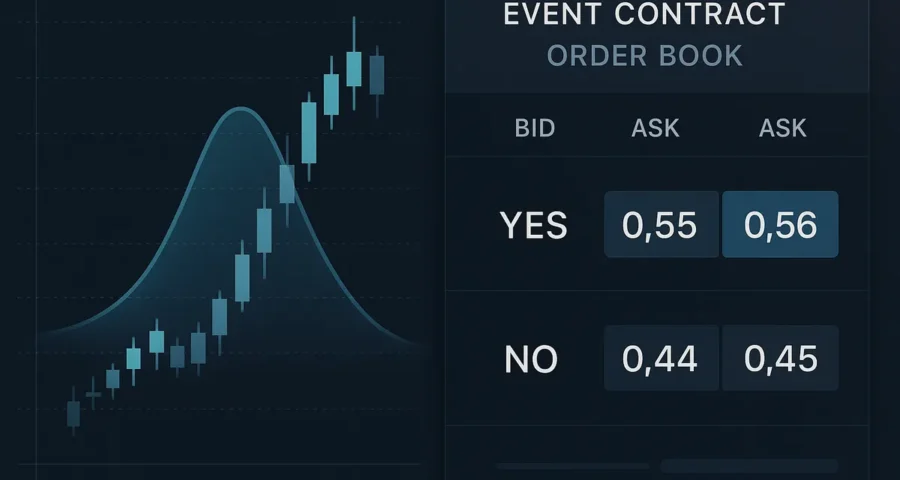
A prediction market is a venue where you buy and sell contracts that pay out if a real-world event happens. That one line is accurate and also slightly misleading, because the thing that makes these markets work isn’t the punters at all. It’s prediction market liquidity: the quiet, unglamorous business of someone standing ready to take the other side of your trade at a fair price, every second of the day.
Which is exactly why a firm most retail traders have never heard of just got priced at $90 million. Raven, a market maker for event contracts, closed a financing round led by Coinbase Ventures and CMCC Global at a $90 million pre-money valuation. No consumer app, no TV ads, no celebrity ambassador. Plumbing.
There’s a lot of loose talk around this story, so let’s take the common assumptions one at a time and check them against what the facts actually support.
Prediction markets explained: trading probability, not backing a price
In a prediction market you trade contracts on an outcome, usually priced between 0 and 1 (or 0 to 100 cents). If “India wins the series” trades at 0.62, the market’s collective estimate is a 62% chance. A winning contract settles at 1.00. A losing one settles at zero. You can sell before settlement at whatever the market will pay, which is the part traditional bettors find genuinely strange.
That is structurally different from a sportsbook. A bookmaker sets a price, takes your stake, and carries the risk itself, with a margin baked into the odds. A prediction market matches you against another trader and takes a fee for running the venue. The house isn’t your opponent. The person on the other side of the order book is.
| Feature | Traditional sportsbook | Prediction market |
|---|---|---|
| Counterparty | The operator | Another trader (peer-to-peer) |
| Pricing | Odds set by the book, updated at its discretion | Continuous order book, moves with every trade |
| Operator revenue | Margin / overround built into odds | Trading or settlement fees (models vary) |
| Exiting a position | Rarely, via cash-out at the book’s price | Sell your contracts at the market price any time |
| Typical markets | Sport, racing, some novelty | Sport, elections, economic data, company events |
| Winning accounts | Can be limited or restricted | No inherent reason to restrict volume |
Two things that do not change: you can still lose everything you stake, and the venue still takes a cut. Peer-to-peer removes the bookmaker’s margin, not the cost of participating and not the risk.
Myth: “Raven raised $90 million”
It didn’t, or at least nobody has said so. The $90 million is Raven’s pre-money valuation in the latest round, led by Coinbase Ventures and CMCC Global. The amounts the two investors put in were not disclosed. Headlines that turn a valuation into a cheque size are the most common error in this story.
The valuation trajectory is the more interesting number. Raven was valued at $25 million after a $2.7 million seed round in 2024, led by Hack VC with participation from Wintermute Ventures and others. Tripling that in roughly a year, for a firm founded in 2023 that only started making markets in event contracts in the second quarter of 2025, tells you how fast capital is repricing this niche.
| Round | Lead investors | Valuation |
|---|---|---|
| Seed, 2024 ($2.7M) | Hack VC, with Wintermute Ventures and others | $25M (post-seed) |
| Latest round (size undisclosed) | Coinbase Ventures, CMCC Global | $90M pre-money |
CMCC co-founder Charlie Morris is joining Raven’s board, which is the detail that signals a long-term position rather than a passive cheque.
Myth: a market liquidity provider is just the house wearing a different hat
No. A market maker’s job is to quote both sides and get paid for the risk of being there, not to win against you.
Think of a stock exchange. When you hit “buy” on a share, you’re rarely waiting for another retail investor to coincidentally want to sell that exact quantity at that exact moment. A market maker posts a bid (what it will pay) and an ask (what it will sell at), and pockets the spread between them. Raven describes itself as an algorithmic high-frequency trading firm, and alongside event contracts it provides liquidity in traditional financial assets, digital assets and token projects across both centralised and decentralised venues. Same discipline, different instrument.
In prediction markets that function matters more than usual, because the contracts are short-lived and fragmented. A single election can spawn dozens of markets. An NBA game spawns more. Raven has made markets in thousands of event contracts since entering the space. Without firms doing that work, the practical effects are ugly:
- Dead order books. You want to buy “Yes” at 0.40 and the nearest seller is at 0.58. That 18-cent spread is your cost of entry.
- No exit. You can be right about an outcome and still be stuck holding contracts you can’t sell at a sane price.
- Garbage prices. A prediction market’s whole claim to usefulness is that the price reflects a probability. Thin markets drift away from reality and the signal stops being worth anything.
As Gemini’s research on the topic puts it, without market makers prediction markets would be illiquid, slow and inaccurate; competition between them tightens spreads over time and keeps the price of a “Yes” share honest as a probability estimate. That is the actual product Raven sells, and it is why a market maker can be worth more than many of the apps that depend on it.
Myth: the Coinbase investment is a bet on gambling
It’s a bet on infrastructure, and Coinbase Ventures has been building that position methodically. Its portfolio already includes Billy Bets, an autonomous AI agent that trades sports event contracts on platforms such as Polymarket; Earlybird, a prediction market for trading on outcomes at privately held companies; and Limitless, one of the larger prediction markets operating outside the US.
Read those together and the thesis is obvious. Coinbase isn’t trying to pick which prediction market app wins the consumer land grab. It’s buying exposure to the layers every app needs: the liquidity, the agents that trade, the venues for new contract types. Picks and shovels. The broader flow of institutional money into the sector, including reported nine-figure commitments into Polymarket, suggests plenty of others have reached the same conclusion.
Worth keeping in perspective: venture investors are paid to be early and are frequently wrong. A $90 million valuation is a bet that volumes keep compounding and that regulators keep opening doors. Neither is guaranteed.
Myth: betting markets like these always give you better odds
Usually better, not always. Here’s the honest version of the maths.
A typical two-way sportsbook market priced at 1.91 on each side implies about 52.4% per side, or roughly 104.8% in total. That extra 4.8% is the book’s margin, charged whether you win or lose. In a liquid prediction market, “Yes” at 0.55 and “No” at 0.45 sum to exactly 1.00, and your real cost is the bid-ask spread plus whatever fee the venue charges. On a heavily traded market with a one-cent spread, that’s a meaningfully cheaper way to express the same opinion.
Flip to an obscure market with no market maker and the comparison inverts fast. A five-cent spread on a 50/50 contract is a 10% round-trip cost, far worse than any mainstream book. Liquidity is not a nice-to-have here, it’s the entire value proposition. That’s the part casual traders miss when they compare a prediction market screenshot to sportsbook odds.
Beyond price, three genuine advantages keep pulling new users in:
- Hedging real exposure. A contract on an interest-rate decision or an election outcome can offset a risk you already carry in your business or portfolio. No sportsbook offers that.
- Information discovery. A continuously traded probability is useful to journalists, analysts and researchers in a way fixed odds never were.
- Two-way markets. You can sell as easily as buy, trade in and out as news breaks, and manage a position instead of waiting for a result. If you’ve read our guides on how different betting market types work, this will feel familiar in structure and completely different in practice.
Regulatory clarity is improving in pockets too. In the US, event contracts traded on CFTC-regulated exchanges sit under financial rather than gambling supervision, which is a large part of why institutional capital is comfortable here at all. “Improving in some jurisdictions” is the accurate framing, not “sorted everywhere”.
Myth: because it’s called trading, it’s legal in India
This is the assumption that costs Indian users money, and it needs flattening.
India’s Promotion and Regulation of Online Gaming Act, 2025 prohibits offering online money gaming services, and the definition turns on whether a user pays money or stakes value in expectation of a monetary return. Critically, it applies regardless of whether the activity is framed as a game of skill or chance. That old skill-versus-chance argument, which fantasy sports and rummy operators leaned on for years, does not help a paid event contract.
The “opinion trading” apps that marketed themselves as a trading product rather than betting have already drawn regulatory and advertising scrutiny on exactly that basis. And prediction markets do not sit inside India’s securities framework either: an event contract on a cricket match is not a recognised instrument supervised by SEBI, and there is no domestic exchange offering one. Foreign platforms, meanwhile, generally geo-restrict Indian users, and sending money abroad for such activity raises its own payment and exchange-control problems.
For Indian readers the practical position is: treat global prediction markets as a sector to understand, not a venue to fund. The regulatory picture here has moved quickly and continues to be contested, so verify the current law before acting on anything, and take advice if real money is involved. If you’re interested in the technology side, our coverage of crypto betting and on-chain wagering explains how the same infrastructure questions play out elsewhere.
What the Raven round actually tells us
Strip away the hype and one signal remains: serious investors now believe prediction market liquidity is a durable business, not a cycle-dependent crypto trade. Market makers get valued on expected volume. A tripling valuation inside a year means someone is modelling a lot more event contracts changing hands in the next few years, across more asset classes and more jurisdictions.
If that plays out, the long-term consequence for bettors is competitive pressure. Peer-to-peer venues with tight spreads and no restrictions on winning accounts are an uncomfortable comparison for a sportsbook charging a 5% overround. Expect books to respond on price and product rather than quietly cede ground.
None of that changes the core discipline. A cheaper spread is still a cost, a probability is still a probability, and being right about the world is still hard. Trade or bet only what you can afford to lose, set limits before you start, and if it stops feeling like a decision and starts feeling like a compulsion, use the self-exclusion and cool-off tools the platform offers or contact a support service. Prediction markets are a better-designed way to take a position. They are not a way to make money reliably.
Frequently asked questions
What are prediction markets?
Markets where you buy and sell contracts tied to real-world outcomes, priced between 0 and 1 so the price reads as a probability. A winning contract settles at 1.00, a losing one at zero, and you can usually sell your position before the event resolves.
How do liquidity providers work?
A market maker continuously posts both a buy price (bid) and a sell price (ask) on a contract, so traders always have a counterparty. It earns the spread between the two and manages its own risk across many positions. More competing market makers means tighter spreads and cheaper trading.
Why did Coinbase invest in Raven?
Coinbase Ventures co-led a round valuing Raven at $90 million pre-money because market making is the infrastructure prediction markets cannot function without. It fits an existing pattern of prediction market investments including Billy Bets, Earlybird and Limitless, suggesting a bet on the sector’s plumbing rather than on one consumer brand.
Are prediction markets legal in India?
Paid real-money prediction markets fall foul of the Promotion and Regulation of Online Gaming Act, 2025, which bans online money gaming services whether skill or chance based. They are not regulated as securities either, and foreign platforms typically block Indian users. Check the current legal position before engaging with any such platform.
Leave a Reply