
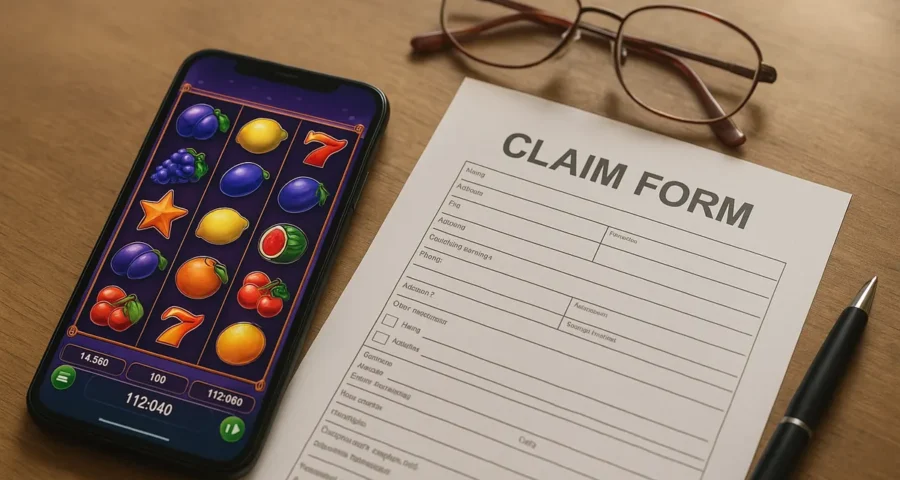
What a social casino refund is, and why one developer is paying $3.2 million
Playstudios, one of the larger developers of free-to-play casino apps, agreed to a $3.2 million settlement to end a class action over virtual chips that were never worth a single cent in cash. That, in a sentence, is what a social casino refund is: money returned to people who bought in-game currency in a casino-style app, paid out through a legal settlement rather than through customer support.
The distinction that makes this possible is narrow but important. A social casino is free to download and free to play. You get a daily allowance of chips, you spin, and when the chips run out you either wait for the next top-up or buy more with real money through an in-app purchase. What you can never do is cash those chips out. There is no withdrawal button, no payout, no balance to convert back to dollars.
Sweepstakes casinos work differently. They run a second currency, usually called sweeps coins, that can be redeemed for cash prizes. Social casino tokens have no real-world value at all, which is exactly the defence developers lean on: this is entertainment, not gambling. The lawsuits argue the opposite, and in several states they have been persuasive enough to end in nine-figure numbers.
The legal argument: how a free game ends up in gambling court
The case at the centre of the Playstudios settlement, White, et al. v. Playstudios, was filed in the Franklin County Circuit Court in Alabama. The complaint alleged the company violated state gambling laws by selling virtual currency that let players keep playing casino-style games after their free credits ran dry. Playstudios asked the court to dismiss it, arguing its apps are legal, free social entertainment rather than gambling systems. It denied every claim, then agreed in July to settle for $3.2 million to avoid further litigation.
That pattern repeats across almost every social casino class action, and the legal plumbing usually comes down to three arguments.
- Gambling loss recovery statutes. A handful of states have old laws on the books that let someone recover money lost at an unlawful game. If a court accepts that buying chips to spin a virtual slot is a wager, those statutes turn in-app purchases into recoverable losses. This is the engine behind most of these cases, and it explains why the plaintiff states are such a specific list rather than all 50.
- The “thing of value” question. State gambling definitions typically require a prize of value. The breakthrough for plaintiffs came in Washington, where the Ninth Circuit held in Kater v. Churchill Downs that virtual chips extending gameplay could count as a thing of value. Big Fish Games and Churchill Downs later resolved that litigation for a reported $155 million, and DoubleDown Interactive and IGT settled related Washington claims for a reported $415 million. Those numbers are why plaintiffs’ firms kept filing.
- Consumer protection and unjust enrichment. Where gambling law does not fit, claims get framed as deceptive or unfair trade practices: misleading odds presentation, aggressive monetisation of players who have already spent heavily, or retaining money from transactions that should never have been offered in the first place.
Worth saying plainly: a settlement is not a finding of guilt. Playstudios denied the allegations and the court never ruled on whether its apps are gambling. Companies settle because litigation across multiple states is expensive and unpredictable, not because they have conceded the argument.
Who qualifies: the eligibility fine print
Player eligibility in these cases is mechanical, not moral. You either fall inside the class definition or you do not, and it usually turns on three things: where you were, when you bought, and which app you bought in.
The Playstudios class covers anyone in Alabama, Ohio, New Jersey, Massachusetts, Tennessee or Kentucky who spent money in the company’s apps during a state-specific window. Those windows look arbitrary until you realise they track each state’s own limitation period and loss recovery law.
| State | Qualifying purchase period |
|---|---|
| Alabama | 8 March 2022 – 30 June 2026 |
| Ohio | 26 July 2022 – 30 June 2026 |
| New Jersey | 2 January 2024 – 30 June 2026 |
| Massachusetts | 26 July 2022 – 30 June 2026 |
| Tennessee | 26 July 2022 – 30 June 2026 |
| Kentucky | 5 July 2018 – 29 June 2023 |
Note how different Kentucky is: a much longer runway, but one that closed in mid-2023. If you spent money in a qualifying app in Kentucky in 2024, you are outside that class even though a neighbour in Ohio buying the same chip pack the same day is inside it. That is the reality of state-by-state litigation.
The qualifying games are named individually too. For this settlement they include myVEGAS, myVEGAS Facebook, myVEGAS Mobile, Pop! Slots, myKONAMI Slots, MGM Slots Live, myVEGAS Blackjack and myVEGAS Bingo. Spending in a different developer’s app does nothing for you here.
Documentation is usually lighter than people expect. The defendant’s own purchase records normally identify the class, which is why many people get an email or in-app notice rather than having to prove anything. If you need to support a claim yourself, app store purchase history from Apple or Google and the receipt emails tied to your account are the practical evidence. There is no spending threshold in this settlement, but payouts are generally proportional to what you spent, so a $4.99 chip pack and a $4,000 spending history are not treated the same.
From claim form to payout: how these settlements work
The process is slower and more bureaucratic than a refund request, and it runs roughly like this:
- Filing and early motions. Named plaintiffs sue on behalf of a class. The defendant typically moves to dismiss, as Playstudios did.
- Negotiated settlement. The parties agree a fund and a class definition without admitting liability.
- Preliminary approval. A judge signs off on the deal and the notice plan.
- Notice to the class. Emails, in-app messages, mailed notices and a dedicated administrator website.
- Claim or election forms. Class members say whether they want cash, virtual currency, or a mix. In the Playstudios settlement, forms are submitted at the official administrator site, gamingappsettlement.com, online or by mail, with a 21 October 2026 deadline. Deadlines move, so check the administrator’s site rather than trusting a date in an article.
- Objections and exclusions. You can opt out, which means no money but you keep the right to sue separately.
- Final approval and distribution. After a fairness hearing, and any appeals, the administrator pays out. Months, sometimes a year or more.
One detail deserves more attention than it usually gets: in this settlement, class members who do nothing receive their benefit in virtual currency by default. Read that again. The remedy for having spent too much on chips can be more chips, unless you actively tell the administrator otherwise. If you think that quietly serves the free to play casino business model better than it serves the player, I would not argue with you. And accepting benefits releases your right to bring future claims over the same conduct.
What the settlement trend tells us about social casino apps
Three things are happening at once. State gambling loss recovery statutes have turned out to be a durable hook, so filings keep spreading beyond Washington into states like Alabama, Ohio, Tennessee and Kentucky. Settlement sizes vary wildly, from the hundreds of millions in the early Washington cases to the $3.2 million here, mostly reflecting class size and purchase volume rather than how serious the conduct was. And the industry has not stood still: several operators have pushed into sweepstakes formats, which carry their own regulatory heat, with multiple states moving to restrict or ban them.
For players, the practical lesson is less about windfalls than about expectations. A social casino refund is a slice of a capped fund, split across thousands of people, usually arriving long after the money was spent. It is not a reason to spend more now on the theory that a lawsuit might claw some of it back later. Treat in-app purchases in a free-to-play casino app as entertainment spending that is gone the moment you tap buy, because that is the deal the terms describe, and set a monthly cap you would be comfortable losing. If your spending on casino-style apps feels compulsive, free support services exist in most countries, and app-level purchase limits on iOS and Android are the fastest brake available.
Nothing here is legal advice. If you think you fall inside a class, the settlement administrator’s official website is the only place that can confirm it.
Frequently asked questions
What is a social casino refund?
It is a payment returned to players who bought virtual currency in a casino-style mobile app, awarded through a class action settlement. The refund covers in-app purchases, not losses, because social casino chips never had cash value to begin with.
How do social casino refunds work?
A court approves a settlement fund, an administrator notifies eligible players, and those players submit a claim or election form by a deadline. Payment, virtual currency, or both may be offered, and distribution happens after final approval.
Who qualifies for social casino refunds?
Only people who match the class definition: a purchase in a named app, made in a listed state, during a specific date range. In the Playstudios settlement that means Alabama, Ohio, New Jersey, Massachusetts, Tennessee or Kentucky, each with its own window.
Why are social casinos paying refunds?
Because plaintiffs have persuaded courts that selling chips to extend play may breach state gambling or consumer protection laws, and defending that across several states is costly. Companies settle while denying liability, as Playstudios did.
Leave a Reply