
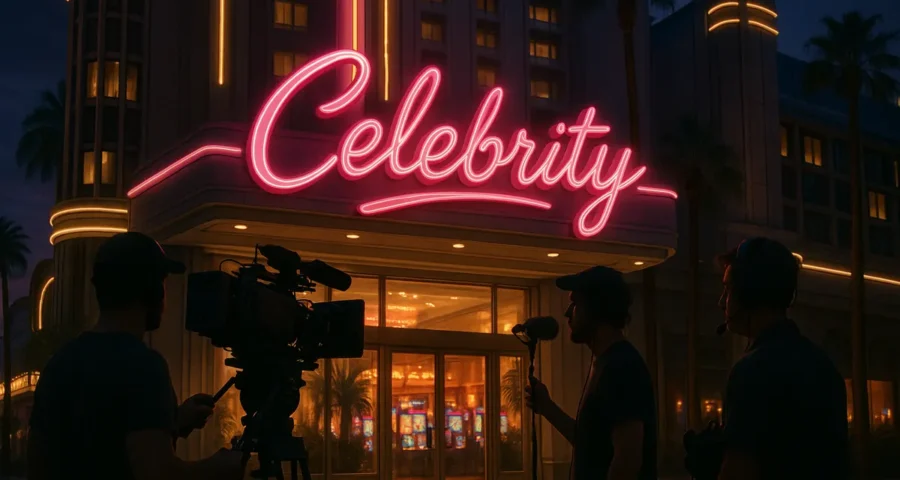
Lisa Vanderpump does not own a Las Vegas casino. That one sentence clears up most of the confusion around celebrity-branded resorts. The Vanderpump Hotel Las Vegas is the former Cromwell, redesigned and rebranded under a partnership with Caesars Entertainment, and it opened on June 11, 2026. The gaming licence, the slot floor, the table games and the revenue sit with Caesars. The name on the building is a marketing asset.
Understanding that distinction is the starting point for reading Las Vegas casino resort entertainment the way the operators themselves read it: as a customer acquisition system with a famous face bolted to the front. Here’s how to decode it, step by step, so you know what you’re actually buying when you book a celebrity-branded room or walk into a themed cocktail garden.
Step 1: See what Las Vegas casino resort entertainment is actually selling
An integrated resort is a single property bundling hotel rooms, restaurants, bars, nightlife, retail, pools, spas, meeting space and a casino floor. Each piece feeds the others. The restaurant brings you on site, the show keeps you there after dinner, the pool fills the afternoon, and the casino sits in the middle of all of it, because the gaming floor is almost always the route between where you are and where you’re going.
Celebrity casino branding is simply one more way to fill the front of that funnel. Instead of buying awareness through conventional advertising, the resort rents an existing audience. Lisa Vanderpump arrived with a built-in one: Bravo viewers who already knew her restaurants, her design taste and her dogs. The Caesars relationship had been building for years before the hotel, through Vanderpump Cocktail Garden at Caesars Palace, Vanderpump à Paris at Paris Las Vegas and Pinky’s at the Flamingo. The hotel was the escalation, not the experiment.
Notice what that means practically. You are not choosing between a “celebrity hotel” and a “casino hotel.” You’re choosing a casino hotel whose positioning, colour palette, playlist and price point were chosen to attract a specific demographic. In this case: a largely female, social, 25-to-45 crowd that wants photographs, cocktails and a bit of camp.
Step 2: Trace the funnel from reality TV to the casino floor
Reality TV marketing works because it doesn’t look like marketing. The three-part Bravo special Vanderpump Rules: Lisa Las Vegas documented the frantic run-up to opening, holes in the ceiling, crumbling stone columns, carpets stuck in customs, an unfinished bar. It aired over two October nights and hit Peacock the following day. Caesars executives including CEO Tom Reeg, COO Anthony Carano and regional president Sean McBurney appear on camera, frowning at problems.
Watch the mechanics rather than the drama:
- Hours of screen time instead of a 30-second spot. A limited series gives the property a sustained, narrative introduction no ad buy can replicate.
- Emotional framing. You meet the hotel through someone’s stress, not through a rate card. By the end you’re invested in whether the lobby gets finished.
- Curation. All reality television is edited. Nothing in a special like this is going to make the casino operator look bad, which is precisely why operators cooperate.
- Searchable aftermath. The trailer, the recaps, the clips and the social arguments keep the property’s name circulating for months. Vegas hotel experiences live or die on that kind of ambient visibility.
- The booking. The whole chain ends with a room reservation, a dinner booking or a walk-in at the bar, all of which put you inside a building with a casino in it.
That last step is the point. The television special isn’t trying to make you gamble. It’s trying to get you on the property. Everything after that is the resort’s job.
Step 3: Follow the money in casino resort marketing deals
Specific terms of celebrity partnerships are rarely disclosed, and the Vanderpump arrangement with Caesars is no exception, so treat anyone quoting precise figures with suspicion. What you can identify is the shape of these deals, because the industry uses a small number of standard structures.
| Deal structure | How the celebrity is paid | What the operator gets | Who carries the risk |
|---|---|---|---|
| Name licence | Flat fee or fee plus bonus | Brand recognition with no operational handover | Mostly the operator |
| Revenue share | Percentage of venue or outlet revenue | Incentive aligned with performance | Shared |
| Management or design partnership | Fees plus share, with creative control | A distinctive product that is hard to copy | Shared, with more celebrity exposure |
| Equity stake | Ownership interest in the venue | A partner with long term commitment | Genuinely shared |
The return on investment case for the operator is less glamorous than the branding. A rebrand of an existing property costs far less than building a new one, and it resets the property’s position in the market without adding a single room. Gaming regulation also matters here: anyone with a meaningful financial interest in a Nevada casino operation faces a suitability review by the state’s regulators, which is one reason many celebrity deals stay on the restaurant, nightlife and design side rather than touching the gaming floor directly. You can read how that licensing framework operates via the Nevada Gaming Control Board.
There’s a second payoff that doesn’t show up as a line item. On the Strip, non-gaming revenue from rooms, food, beverage and entertainment has for years accounted for the larger share of resort income. Celebrity partnerships push directly on that half of the business, and they do it while generating press coverage the marketing department didn’t have to buy.
Step 4: Audit what the branding changes, and what it doesn’t
Here’s the practical test. Walk through a celebrity-branded property and sort what you see into two piles.
Things the branding genuinely changes: interior design and room décor, food and cocktail programmes, music and dress code, the kind of crowd you’ll be standing next to, Instagram-ready set pieces like the Giggy’s lounge statue, and often the room rate. A distinctive design-led product can justify a premium, and operators price accordingly.
Things the branding does not change: the mathematics of the games. A rebranded casino floor does not alter the house edge. European roulette keeps its 2.7% edge and double-zero American roulette keeps its 5.26% no matter whose name is on the marquee. Slot RTP is set by the game and its configuration, usually somewhere around 88% to 96% on Strip floors, and no amount of pink neon moves that number. Nor does celebrity involvement change payout speed, comp formulas or the structure of the loyalty programme.
So when you assess value at integrated resorts, split your judgement. Judge the hotel on the hotel: room quality, location, food, service, resort fees. Judge the casino on the casino: table minimums, rules variants such as whether blackjack pays 3:2 or 6:5, and the games on offer. Those are two separate purchases that happen to share an address.
Step 5: Separate entertainment from gambling in your own head
The psychology at work is uncontroversial and well documented in hospitality marketing: familiarity breeds trust, and trust lowers your guard. When a property feels like somewhere you already know, from a show you already watch, hosted by a personality you already like, three things tend to happen.
- Spending feels social rather than financial. A round of drinks and a few hands at a table read as part of the night out, not as a budget decision.
- The casino becomes scenery. You came for the restaurant or the bar. The gaming floor is just what you cross, and crossing it repeatedly is how incidental play starts.
- Aspiration quietly inflates stakes. Environments that signal luxury nudge people towards spending that matches the setting rather than the bankroll.
None of this is sinister, and none of it is unique to celebrity properties. It’s the same experiential marketing logic a cruise line or a theme park uses. But the entertainment versus gambling distinction is worth holding onto deliberately, because the resort has every reason to blur it and you have every reason not to.
A workable approach: decide your gambling budget before you arrive and treat it as entertainment spending that you expect to lose, because over time the house edge means that’s the mathematically likely outcome. Keep dinner, drinks and room spending in a separate mental account. Use the deposit, loss and session limits available at any licensed operator, and set a time you’ll leave the floor. If play stops feeling like entertainment, step away, and use self-exclusion or cool-off tools if you need them. Organisations such as the National Council on Problem Gambling offer free, confidential support.
Frequently asked questions
How do celebrity hotels attract gamblers?
Indirectly. They attract visitors with design, food, nightlife and media coverage, then rely on the layout of an integrated resort to put those visitors in regular contact with the casino floor. The pitch is the lifestyle, not the gambling.
What is integrated resort marketing?
It’s marketing a property as one bundled experience, hotel, dining, nightlife, pool, retail and casino, rather than promoting each element separately. The goal is to get you on site for any reason and keep you on site, since every hour spent there is an hour of potential spending across several revenue streams.
Why do casinos partner with celebrities?
Because a partnership rents an existing audience and a ready-made identity, usually for less than the cost of building brand awareness from scratch. It also sharpens positioning. Converting the Cromwell into the Vanderpump Hotel gave Caesars a clearly targeted product on a crowded Strip without constructing anything new.
How does entertainment marketing work in Vegas?
Residencies, celebrity restaurants, nightclubs, sports partnerships and television specials all feed the same funnel: generate attention, convert attention into visits, then monetise the visit across rooms, food, beverage, entertainment and gaming. Entertainment is the acquisition cost; the resort is where the return is collected.
Read a celebrity-branded resort this way and the marketing stops being persuasive and starts being interesting. Enjoy the hotel for what it is, a well-designed piece of theatre built by people who are very good at their jobs, and keep your assessment of the casino floor on the numbers.
Leave a Reply