
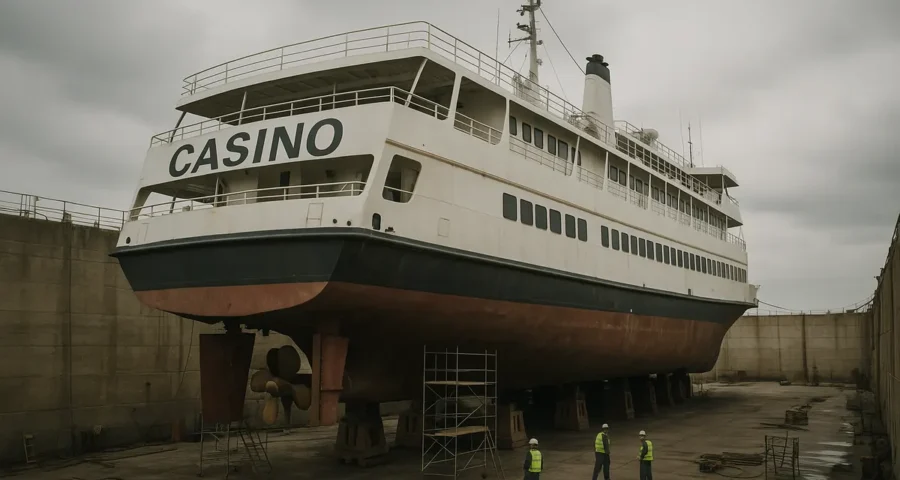
On a normal Tuesday afternoon at Port Canaveral, a coach pulls up at Terminal B-2 and 200 regulars file aboard a boat with more than 600 slot machines. Forty-five minutes later, once the ship crosses into international waters, the floor opens and the money starts moving. Then one Sunday in late September, the sailings stopped. Victory I, the only ship Victory Casino Cruises has, went into an extended dry dock for mechanical work, reservations were refunded, and the crew was put on furlough.
That is the whole fragility of casino cruise ship operations in one sentence. A land casino with a broken chiller keeps dealing cards. A floating casino whose hull has to come out of the water earns nothing at all.
How casino cruise ship operations make money
The day-boat model is simple, and that simplicity is both its strength and its weakness. The ship sails a short loop from a home port, opens its casino once it is legally allowed to, runs for a few hours, and comes back. Victory I did this twice a day, Tuesday through Sunday, from the same terminal for 16 years, carrying more than three million gamblers in that time.
Revenue arrives in three layers:
- The door. Boarding was $25 per person, with discounts for groups of 10 or more. It is a modest admission fee, but it covers some fixed cost and filters out pure sightseers.
- The gaming floor. More than 600 slot machines plus live dealer blackjack, craps, roulette, poker and baccarat, with bingo and sports betting alongside. This is where almost all the margin sits.
- Everything else. Food, retail, and in Victory’s case free alcoholic drinks while gambling, which is a cost deliberately traded for longer time on device.
Operators don’t talk much about revenue per passenger, and credible public figures for individual day boats are thin, so treat any precise number you see with suspicion. The mechanics, though, are not mysterious. Suppose a player buys in with $100 and plays slots with a 92% RTP. The house keeps roughly $8 of every $100 wagered, not $8 of the buy-in, because winnings get re-wagered. A $100 bankroll can easily cycle through several hundred dollars of total coin-in before it is gone. Multiply a modest average loss per head by a few hundred heads, twice a day, six days a week, and you have the business.
Cruise ship casino revenue therefore scales with two things only: bodies on the boat and hours the floor is open. Lose either one and there is no substitute income stream.
Why the ship has to leave port before the slots switch on
The reason a day boat exists at all is jurisdictional. Casino gaming aboard these vessels is not permitted while the ship sits in state waters, so the floor stays locked, sealed or powered down until the vessel clears the boundary. International waters begin 12 nautical miles from the coast, where a country’s territorial sea ends, which in practical terms meant Victory I’s casino opened about 45 minutes after departure.
Offshore casino operations work differently from a land venue in ways that matter to the economics:
- Gaming license jurisdiction. A land casino holds a state licence tied to a building and pays state gaming tax on gross gaming revenue. A day boat’s gaming authority flows from where it is when the games run, plus its flag state and maritime registration. Different rulebook, different regulator, different reporting.
- The product is the voyage. Gambling time is capped by sailing time. A land casino can open 24 hours; a day boat sells a fixed number of hours per sailing and cannot add more without adding sailings.
- No standing floor. The venue physically has to move to be legal. That ties the gambling business to engines, hulls, weather and maritime safety law.
That last point is the hinge. Maritime gambling inherits every obligation of a passenger ship, including the one that stops everything.
What a casino ship dry dock actually involves
A dry dock is exactly what it sounds like: the vessel is floated into a basin or a floating dock, the water is pumped out, and the ship sits on blocks with its hull fully exposed. It is the only way to properly inspect and work on the parts that are normally underwater, such as the hull plating, propellers, shafts, rudders, sea valves and underwater coatings.
It is also not optional. Under international safety rules administered through the International Maritime Organization and enforced by flag states and classification societies, the outside of a passenger ship’s bottom must be inspected on a recurring cycle, with limits on how long a vessel can go between inspections. Surveys, certificates and class status all hang on it. Without valid certificates, the ship does not sail, and if the ship does not sail, there is no legal gambling.
A planned docking for survey and coatings might run a couple of weeks. Extensions are routine, and they happen for a predictable reason: you cannot see inside machinery until you open it. Victory said the work was mechanical rather than cosmetic, explicitly not new carpet, lighting or gaming machines, and that additional necessary work pushed the vessel out of service longer than hoped. That is the classic pattern. Yard work is scoped from estimates and re-scoped from findings.
Why does the casino close completely rather than operate at the quay? Because the floor’s legality depends on position, and the ship’s position during a dry dock is on blocks in a shipyard. There is no partial-trading option. Gaming stops at 100%.
The cost of an idle boat: lost revenue and furloughed crew
Here is the asymmetry that defines floating casino gambling. Revenue goes to zero on day one. Costs do not.
| Stops the moment the ship is out of service | Keeps running anyway |
|---|---|
| Slot and table gaming revenue | Shipyard and dry dock fees |
| Boarding fees | Repairs, parts and contractor labour |
| Bingo and sports betting | Hull and liability insurance |
| Onboard food, drink and retail spend | Vessel financing or lease payments |
| Future bookings (refunded, and paused) | Port terminal lease and shoreside admin |
| Player loyalty visit frequency | Core management and essential crew |
Victory refunded all paid reservations and deposits and put future bookings on hold, which converts a chunk of already-banked cash back into an outflow at the worst possible moment.
The human side lands hardest on the crew. Staff said they had been placed on furlough, which is temporary mandatory leave without pay, though some employers continue benefits. Furloughed workers in the US can apply for unemployment benefits and may be able to continue health coverage under COBRA through the Department of Labor. For gaming staff, the gap is worse than the base wage suggests: dealers and slot attendants on a day boat depend on tip income tied directly to passenger volume, and passenger volume is zero.
Crew employment is also what makes the restart tricky. Let a trained floor go and you don’t rehire it instantly. Licensed dealers, cage staff, surveillance and the mariners who actually run the ship all have to be available on the day the yard hands the vessel back.
Why ship-based gambling venues are structurally fragile
Compare the risk profile with a land casino and the gaps are obvious.
- Single-asset concentration. Victory I is the company’s only ship. One vessel out of service means the entire operation is out of service. A regional land operator with three properties can shift players; a one-boat operator cannot.
- Mechanical dependence. The gambling licence effectively runs through the engine room. Propulsion, steering and hull condition are not back-office concerns here, they are the revenue switch.
- Weather and sea state. Storms, high seas and hurricane season cancel sailings outright. A cancelled sailing is perishable inventory. You cannot sell it later.
- No fallback venue. There is no shoreside floor to open instead, no online arm absorbing demand, no way to monetise a loyal customer base while the ship is away.
- Regulatory sensitivity. Changes to state or federal rules on gambling vessels, port access, or safety certification can reshape the model without warning, and the operator has little ability to relocate.
- Operational cost rigidity. Fuel, insurance, crewing and berth costs are high relative to a comparably sized land floor, so the break-even passenger count per sailing is unforgiving.
None of this means day boats are badly run. It means the model trades low regulatory cost and a captive, enthusiastic audience for a concentrated operational risk that a building simply does not carry. The operators who survive long stretches of it tend to be the ones holding a cash cushion sized for an unplanned yard period, not just a planned one.
Common questions about casino cruise ships
How do casino cruise ships work?
A day boat sails from a home port on a short round trip. The casino stays closed while the ship is in state waters and opens once it crosses into international waters, 12 nautical miles offshore. Passengers pay a boarding fee, gamble for a few hours, and return to the same port.
What happens during dry dock?
The ship is lifted out of the water in a shipyard so the hull, propellers, shafts, rudders and sea valves can be inspected and repaired, and required safety surveys can be completed. All passenger sailings and all gambling stop for the duration.
Why do cruise casinos close for maintenance?
Because gambling on these vessels is only legal beyond territorial waters, and a ship on blocks in a yard cannot sail. Safety certification also depends on the survey being completed, so there is no option to trade from the dock.
How much revenue do cruise casinos make?
Individual day boats rarely disclose figures, so be wary of confident numbers. The drivers are passenger count per sailing, sailings per week, boarding fees and the house edge on the games offered. Over the long run, the house edge is what makes the floor profitable, which is the flip side of the same point every player should keep in mind.
A note on the obvious: every game on these ships, afloat or ashore, carries a built-in house edge, which is why the operator’s revenue is the players’ loss. Gamble with money you can afford to lose, set a limit before you board, and use deposit, loss or session limits and self-exclusion tools where they are offered.
Leave a Reply