
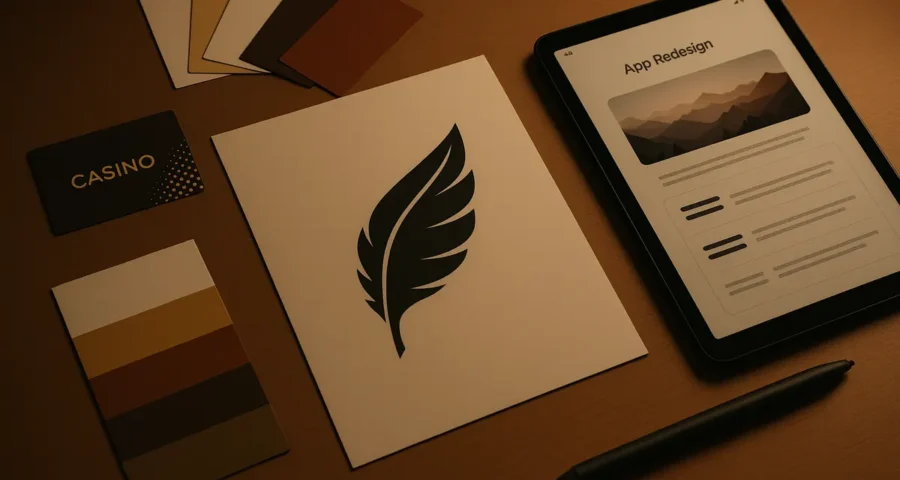
A new logo, a single feather, and a date on the calendar
On a Tuesday in late September, Seneca Resorts & Casinos put out a new corporate logo. One eagle feather, pointing upward, a nod to the gustoweh, the traditional headdress of the Seneca Nation of Indians. President and CEO Kevin Nephew framed it as both a cultural marker and a promise about guest experience. A few hours earlier on the same day, slot manufacturer IGT had unveiled its own brand makeover at the Global Gaming Expo. Two rebrands, one news cycle, same industry.
Pull back from the artwork and the timing explains more than the design does. Seneca’s 25th anniversary lands on January 1, 2027. The feather is not the project. The project is everything scheduled to follow it. That gap between what a brand refresh looks like and what it is actually doing is the useful thing here, and it is why casino brand rebranding is worth reading carefully rather than scrolling past.
What Seneca actually changed, and what it deliberately didn’t
The detail that tells you the most is what stayed put. The new mark applies only to the corporate identity. Seneca Niagara Resort & Casino, Seneca Allegany Resort & Casino and Seneca Buffalo Creek Casino all keep their own names and emblems. Nephew described each property as having its own personality: big moments at Niagara, a quieter escape at Allegany, an urban pace at Buffalo Creek.
That is a specific choice, not a compromise. Property-level brand equity in casinos is built over years through local habit, drive time and familiarity. Repainting the signage on a casino that regulars have visited weekly since the early 2000s destroys value rather than creating it. So the corporate layer gets the refresh, and the properties keep the recognition.
Seneca also said the new identity arrives alongside strategic updates to marketing messaging and ongoing work on guest-facing channels, including the mobile app, the website and social media. The portfolio behind all this is three casinos, three gaming rooms and an 18-hole golf destination, operating in a market where the Seneca Nation holds exclusive rights to slot machines and dealer table games west of State Route 14 in Upstate New York.
Read those pieces together and the shape of the exercise is clear. A milestone anniversary provides the reason to announce. The app and website work is the part that changes what customers experience. The logo is the flag planted at the start.
Why casinos rebrand: the strategic drivers
Casinos rebrand for business reasons that have very little to do with taste. Four drivers account for most of it: competitive pressure, loyalty program restructuring, an aging digital experience, and expansion or ownership changes that require a single identity across properties. Anniversaries, new leadership and major capital projects supply the timing, not the motive.
Market competition and differentiation
Regional casino markets are increasingly crowded, and most of the floor is interchangeable. The same manufacturers supply the slots, the same game studios supply the online content, and table game rules barely vary. When the product is similar, operators compete on what surrounds it: service, atmosphere, food, events, convenience and how a visit makes someone feel.
That is exactly the territory a brand refresh is trying to claim. Seneca’s language about a “Seneca difference” that guests should recognize “digitally or in person” is a differentiation play in a market where a player could reasonably choose a competitor 45 minutes down the road. Market positioning is cheaper to change than a casino floor.
Loyalty program integration
Multi-property operators have a structural problem: a guest who earns status at one property wants that status to mean something at the others. A unified corporate brand is the wrapper that makes a unified rewards currency make sense. The industry’s biggest examples are familiar, Caesars Rewards replacing Total Rewards and MGM Rewards replacing M life Rewards, both arriving as part of broader brand work rather than as standalone announcements.
This is the driver players should care about most, because it is the one that changes account balances, tier thresholds and comp math.
Modernizing the player experience
A logo designed before smartphones existed tends to come with a digital footprint designed the same way. Apps that are slow to load, loyalty balances that are invisible unless you visit a kiosk, offers that arrive by post. Refreshing the brand is often the budget line that finally funds the app rebuild, the single sign-on, the push notifications and the cleaner website. Seneca naming the app, website and social channels in the same breath as the logo fits that pattern.
Where visual identity meets the loyalty program
The connection between a new logo and casino loyalty programs is practical. Rewards schemes run on cards, kiosks, app screens, tier names and printed terms. Change the brand and all of that material gets reprinted anyway, which makes it the cheapest moment to change the rules underneath.
Typical moves that travel with a rebrand:
- Tier names and thresholds reset, sometimes with different qualifying periods.
- Points earning rates are adjusted by game type, with slots usually earning faster than table games.
- Point values shift when the redemption menu changes, so the same balance buys a different amount.
- Separate online and land-based accounts are merged into a single wallet or identity.
- Expiry rules on points and status are tightened or loosened.
- Offers move from mail to app-only, which quietly changes who receives them.
None of these are inherently bad for players. A merged wallet and app-based tier tracking are genuine improvements. But a rebrand is also the easiest cover for a devaluation, because the comparison between old and new terms is harder to make when every label has changed.
How to read a casino brand refresh as a player
Treat the announcement as a signal and go looking for the document that matters. The table below maps the common signals to the thing worth checking.
| What’s announced | Likely driver | What to check |
|---|---|---|
| New corporate logo only, property names kept | Unifying marketing across sites | Whether rewards now transfer between properties |
| New loyalty program name or tier names | Program restructure | Earning rate, tier thresholds, point value, expiry dates |
| New app or website | Digital overhaul | Does your old account, balance and tier carry over intact |
| Rebrand after an ownership or licence change | New operator or platform | Updated terms, payment methods, KYC requirements, withdrawal timelines |
| Heavy bonus promotion alongside the relaunch | Customer acquisition push | Wagering requirements, game weighting, max cashout and max bet caps |
Two red flags are worth naming. The first is a relaunch promotion with wagering requirements noticeably steeper than the operator’s previous offers, which suggests acquisition marketing rather than improved value. A 30x requirement on a bonus means wagering 30 times the bonus amount before withdrawal, and that arithmetic does not improve because the logo did. The second is a tier reset with no grandfathering, where long-standing status disappears and has to be re-earned from zero.
The reassuring signal is a rebrand where the operator publishes a side-by-side comparison of old and new program terms. Operators confident they are improving the deal tend to show the numbers.
Do casino rebrands actually work?
Honest answer: it depends almost entirely on whether anything changed behind the logo, and the evidence is thinner than marketing teams suggest. Casino operators rarely publish retention data tied to a specific rebrand, and when revenue rises after one it usually coincides with a renovation, a new hotel tower, a sportsbook launch or an expanded loyalty network. Separating the brand effect from the capital spend is close to impossible from the outside.
What the industry’s track record does suggest is a pattern. Rebrands that come bundled with a genuine functional change tend to stick, because the player gets something usable: status recognized at more properties, one account instead of two, a working app. The Caesars and MGM program renames endured because they consolidated real benefits across large portfolios. Rebrands that are purely cosmetic tend to leave the underlying problem untouched. If the floor is dated, the drinks service slow and the comps thin, a refreshed wordmark changes brand perception for about a week.
Seneca’s version will be judged the same way. The feather is a coherent piece of identity work with a cultural anchor, and keeping the property emblems shows restraint. Whether it counts as a successful casino marketing strategy depends on what the app rebuild and the “strategic updates to marketing messaging” actually deliver to a regular at Buffalo Creek over the following year. The announcement is the hypothesis. The product is the test.
Either way, the house edge on the floor is unchanged by any of it. A new logo does not alter the RTP of a slot machine, the 2.7% house edge on European roulette or the terms attached to a bonus. Loyalty rewards are a rebate on what you have already wagered, not an edge. Treat a rebrand as useful information about an operator’s priorities, set your own deposit and time limits, and read the new terms before you assume they match the old ones.
Common questions about casino rebranding
Why do casinos rebrand?
To differentiate in crowded regional markets, to unify multiple properties under one identity, to support a loyalty program restructure, to fund and signal a digital overhaul, or because new ownership requires it. Anniversaries and leadership changes usually set the timing.
What triggers a casino brand refresh?
Common triggers are milestone anniversaries, mergers or acquisitions, a loyalty program consolidation, a new app or online platform, and competitive pressure from a nearby opening. Seneca’s refresh precedes its 25th anniversary on January 1, 2027.
How does casino rebranding affect players?
Mostly through the loyalty program and digital accounts. Tier names, earning rates, point values and expiry rules often change at the same time as the visual identity, and online accounts may be migrated. Visually, individual property names frequently stay the same.
Do casino rebrands improve the player experience?
Only when they come with real operational change, such as rewards that transfer across properties, merged online and land-based accounts, or a rebuilt app. A purely cosmetic refresh changes perception without changing value, and game odds never change with it.
Leave a Reply