
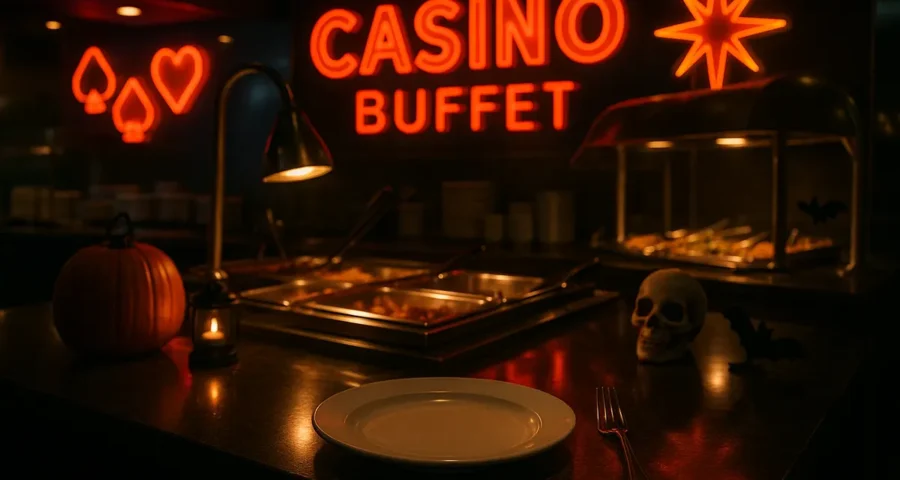
Last October, a job ad circulated that paid $5,000 for one person to eat their way through Las Vegas buffets inside casino resorts with ghost stories attached to them. The title: “‘Boo’ffet Inspector.” No EMF meters, no seances. Just plates, a weekend in Vegas, and a write-up at the end.
Here is the takeaway for anyone working in this industry: the campaign was never really about buffets. It was casino promotional marketing in its purest form, buying attention at a fraction of what the same reach would cost through paid media, then converting that attention into email addresses, backlinks and branded search. One detail makes the point sharper than any case study deck could. The promotion wasn’t run by a casino resort at all. It was run by a gambling media publisher, casino.org, and the resorts picked up incidental coverage for free.
The $5,000 buffet promotion: marketing mechanics, broken down
Strip away the Halloween styling and you find four mechanics doing all the work.
A headline number that functions as the hook. “$5,000 to eat buffets” is instantly repeatable. It survives being retold in a group chat, which is the real distribution test. Note how the terms structure that number, because this is where the budgeting discipline shows:
| Payment stage | Amount | What it covers |
|---|---|---|
| On acceptance of the prize | US $2,500 | Buffet entries, food, drinks, travel within Las Vegas, flights, accommodation |
| On completion of the task | US $2,500 | Fee for delivering the reviews |
| Headline figure | US $5,000 | The number that travels in the share |
So the “$5,000 payday” is half expenses float, half performance fee. That is not deception, it is in the published terms. It is a reminder that the number you promote and the number you spend on the winner’s pocket are different line items, and the gap is where a campaign’s creative framing lives. Marketers copying this model should check that their own framing holds up when a journalist reads the terms page.
Novelty with a low participation barrier. Entry was a single form. Winner selected at random, applications closing 11:59am EST on 31 October. Random selection matters more than it looks: it removes the “I’m not qualified” hesitation that kills application volume in talent-based contests, and it simplifies the legal position in jurisdictions where skill-judged prize promotions carry different rules.
Built-in content deliverables. The winner owes reviews. That means the campaign produces a second wave of publishable material weeks after the entry window shuts, at no extra creative cost. Most promotional stunts die the day the winner is announced. This one has a sequel written into the contract.
Cost against exposure. Add prize, travel, legal review, landing page and a modest outreach push, and the all-in spend lands in the low five figures. One national pickup, a handful of syndicated versions and a few thousand form submissions, and the arithmetic looks very different from a comparable display or paid social buy at the same budget.
Why operators fund experiential marketing instead of more ad spend
Experiential casino marketing exists because the category has a reach problem and a differentiation problem at the same time.
The reach problem is regulatory and platform-driven. Gambling advertising faces restrictions on major ad networks, age-gating requirements, creative pre-approval in several markets, and outright bans in others. Paid channels are narrow and expensive. Earned media isn’t subject to the same gatekeeping, so a story a journalist chooses to publish can reach audiences a media buyer cannot legally or affordably touch.
The differentiation problem is more basic. Welcome offers, free spins and cashback are near-identical across operators and affiliates, and they compete on a single axis: size. A buffet inspector role competes on no axis at all, which is precisely why it gets remembered.
| Dimension | Traditional promo advertising | Experiential campaign |
|---|---|---|
| Primary asset | Bonus offer, media placement | An unusual experience, a story |
| Cost behaviour | Scales linearly with impressions | Mostly fixed; reach can outrun spend |
| Attribution | Clean, pixel-level | Messy, partly modelled |
| Shelf life | Ends with the flight | Backlinks and content persist |
| Main failure mode | Creative fatigue, rising CPMs | Total silence, zero pickup |
| Compliance exposure | Ad-copy rules | Prize-promotion law, terms drafting |
The honest risk is in that fifth row. Paid media guarantees delivery; experiential campaigns can return nothing. A stunt that no publisher covers and nobody shares is simply a cost with a nice landing page attached.
The shareability formula: what actually makes a casino campaign travel
Campaigns that generate real brand buzz tend to share the same ingredients, and the buffet job hits all of them.
- A one-sentence premise. If the idea needs a paragraph to explain, it will not be retold accurately. “Paid $5,000 to review haunted Vegas buffets” is the whole brief.
- A job frame rather than a sweepstake frame. “Dream job” coverage sits in lifestyle, careers and food verticals, not just the promotions roundup where every competitor already lives. That widens the pool of outlets that can justify running it.
- An expiry date. A fixed closing date gives publishers a news peg and readers a reason to act now instead of bookmarking.
- Visual legibility. Buffet spreads, neon, Halloween props. The idea photographs and thumbnails well, which decides whether it survives on social feeds.
- Borrowed narrative. Vegas resort ghost stories are pre-existing cultural material. The campaign rents that interest rather than building a theme from nothing.
- A creator-shaped role. The winner becomes a de facto content partner, producing first-person material with the credibility of a participant rather than the tone of an ad.
Seasonal and themed events as long-term brand assets
Halloween was not decoration here, it was a scheduling decision. Themed casino events work because they attach a brand to a date the audience is already searching, talking and planning around. October delivers elevated appetite for anything spooky; December, March Madness, Valentine’s and New Year do the same in their own windows. The campaign borrows demand that already exists instead of manufacturing it.
The strategic value, though, comes from repetition. A one-off stunt buys a spike. The same themed franchise run annually buys something more durable: a recognisable property, a journalist list that already understands the format, a landing page accruing links each cycle, and an email segment of previous entrants to reactivate. Year two costs less to produce and performs better, because the hardest part, persuading people the thing is real, is already done.
That is also why the Vegas setting earns its place. Buffets, haunted resorts and the Strip are durable associations. A themed campaign anchored in a specific place and tradition can run for years without feeling recycled, where a campaign anchored to a passing meme has roughly six weeks of life.
Measuring the ROI of a promotional campaign like this
Anyone funding this kind of work should agree the scorecard before launch, because “it went viral” is not a number. In practice four layers get measured.
- Earned media. Count placements, referring domains gained, domain authority of linking sites, and syndicated reprints. For publisher-side campaigns, the link profile is often the main commercial objective, since organic rankings in this vertical are the revenue engine.
- Direct response. Form submissions, consented email opt-ins, cost per entry, and the opt-in rate from entrants into ongoing marketing. This is the cleanest figure available. If an all-in spend of, say, $15,000 produces 10,000 entries, that is $1.50 per consented contact, a number you can compare directly against paid acquisition costs in the same market. Run that comparison with your own real figures rather than assumed ones.
- Brand signals. Branded search volume before, during and after the window; direct traffic; social mentions and share-of-voice against competitors. These move slowly and need a clean pre-campaign baseline to mean anything.
- Downstream value. Registration and retention behaviour of the audience the campaign brought in, measured over months. Entrants to a food-and-travel contest are a broad audience, not a pre-qualified one, so assume lower conversion than a bonus-led acquisition channel and price the campaign as reach plus list-building rather than direct acquisition.
Two cautions. First, “advertising value equivalency”, the habit of pricing earned coverage as if you had bought the same space, inflates reported ROI and most serious teams have retired it. Second, measure against a stated hypothesis. A campaign designed for links should be judged on links, not on registrations it was never built to deliver.
Where these campaigns go wrong
The failure modes are predictable. Terms that contradict the headline invite criticism once a reporter reads the fine print. Prize promotions in gambling-adjacent brands attract scrutiny over eligibility, age verification and jurisdiction, so legal sign-off belongs at the concept stage, not the week of launch. And a stunt with no connection to what the brand actually does buys traffic that never recognises the name again.
One more point that is easy to skip. Campaigns built around food, travel and novelty reach a general audience, including people who have no interest in gambling and people for whom it is a problem. Age gating, clear eligibility rules and visible responsible-gambling messaging on the campaign page are not optional extras in a regulated category; they are part of doing this properly. Gambling should be presented as entertainment with a built-in cost over time, never as income, and promotional creative should never suggest otherwise.
Frequently asked questions
How do casinos create viral promotions?
By building a premise that can be retold in one sentence, attaching a concrete headline number, giving it a deadline and a visual hook, and keeping the entry barrier to a single form. Then they pitch it as a story to non-gambling verticals such as lifestyle, careers and food.
What makes casino marketing effective?
Differentiation and distribution. Bonus-led advertising competes only on offer size in channels with heavy restrictions and rising costs. Campaigns that earn coverage reach audiences paid media cannot, and leave behind assets such as backlinks, email lists and recognisable annual formats.
Why do casinos use experiential promotions?
Because gambling advertising faces platform bans, pre-approval regimes and tight creative rules in many markets. An experience that journalists want to write about sidesteps those bottlenecks and produces first-person content with more credibility than an ad unit.
How much do casino promotions cost?
It varies enormously, but stunts of this type typically sit in the low five figures all in: prize, travel, legal review, landing page and outreach. The $5,000 buffet job split its prize into $2,500 upfront for flights, accommodation, buffet entries and local travel, plus $2,500 on completion. Judge the spend on cost per consented entry and earned coverage, not on the headline prize.
Leave a Reply