
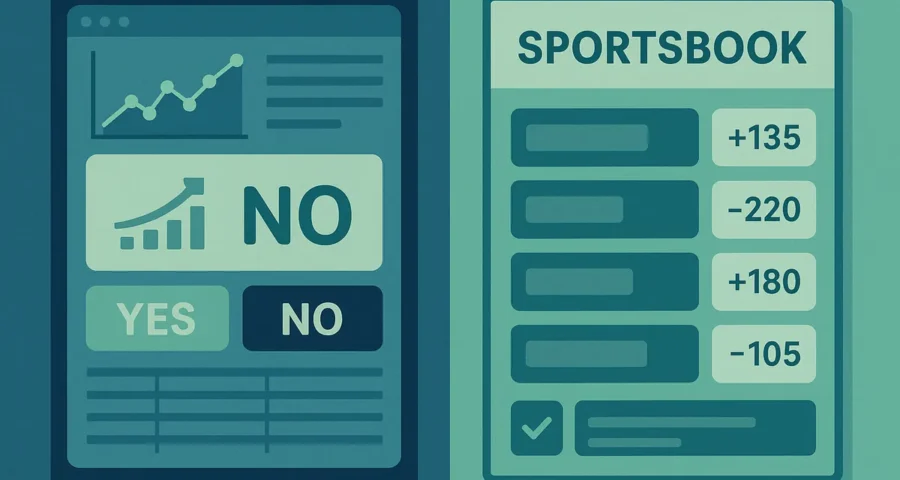
Is a contract on Apple’s iPhone sales a trade or a bet?
Mechanically, it is very close to a bet. Legally, it is about to be a security. That gap is the whole story, and the event trading vs gambling argument has just been handed its sharpest test yet: Robinhood Markets (NASDAQ: HOOD) will become the first retail broker to list Cboe Global Markets’ event contracts tied to corporate earnings reports and other company data points.
The announcement came at Robinhood’s third annual HOOD Summit in Houston. Pending regulatory approval, Cboe said the derivatives could go live on Robinhood in October, which would line them up with the start of third-quarter earnings season. Both companies are waiving fees on the contracts through the end of the year.
If you work in or follow betting, this matters for a simple reason. A product that behaves like a binary wager is being routed through the US securities system rather than state gaming regulators, and the company doing it already runs the fastest-growing business line in its own history on the back of sports event contracts.
What exactly is Robinhood listing?
Cboe filed in July for regulatory approval of binary derivatives tied to 100 key performance indicators across 23 public companies. Expected names in that group include Apple, Coinbase Global, SpaceX, Tesla and Robinhood itself.
The design point is the interesting part. These are not contracts on a share price. They settle on discrete, published data points, the kind of number a company reports or a counter you can verify afterwards:
- Apple iPhone sales
- SpaceX rocket or satellite launches
- Deliveries of specific Tesla models
Binary means there are two outcomes. The metric lands above the threshold or it does not, and the contract resolves to a fixed value or to nothing. You are not taking a position on a stock’s direction with open-ended upside. You are taking a yes or no position on a stated fact, and the price you pay reflects the market’s implied probability of that fact.
Anyone who has priced a sportsbook market will recognise the shape of that immediately. A yes contract trading at 62 is the same information as odds of around 1.61 in decimal terms, minus the sportsbook’s margin and plus whatever the exchange charges. That is why the comparison keeps coming up, and why “event trading vs gambling” is not a lazy headline.
How is this different from Kalshi or Polymarket?
The difference Cboe is pressing is the regulator, not the mechanics. In its own words, the KPI binary options will let investors take positions on specific company metrics and corporate events “through Securities and Exchange Commission (SEC)-regulated products traded on Cboe’s registered U.S. securities exchange.”
Cboe explicitly separated its framework from the event-based contracts already trading on designated contract markets, the CFTC-regulated venues where today’s prediction markets sit. It argues these products belong inside the transparency, oversight and investor protections of the securities markets, and it flagged one practical consequence: federal preemption of state securities registration requirements.
There is also a content difference. Most corporate event contracts on existing prediction markets track stock price moves or corporate actions such as mergers, acquisitions and IPO filings. Kalshi traders, for example, have priced the odds of a Caesars acquisition. Cboe is going after the operational numbers underneath the business instead.
| Feature | Cboe KPI binary options | Prediction market event contracts | Sportsbook wager |
|---|---|---|---|
| Primary regulator | SEC, on a registered securities exchange | CFTC, via designated contract markets | State gaming regulators, licence by licence |
| What settles it | A published company KPI (e.g. unit sales, deliveries, launches) | Stock moves, corporate actions, sports, politics and more | The result of a sporting event |
| Payout shape | Binary: fixed value or nothing | Binary: fixed value or nothing | Stake multiplied by fixed odds |
| Counterparty | Other market participants via the exchange | Other traders on the exchange | The operator takes the other side |
| Where the operator’s margin comes from | Fees and spread (fees waived into year end) | Trading fees and spread | Built-in overround on the odds |
So is event trading gambling?
The honest answer depends on which question you are asking.
Ask an economist and the line is thin. Both involve staking money on an uncertain outcome you do not control, both are priced as probabilities, and in both cases the venue takes a cut, so the average participant loses money over time. The cut is smaller on an exchange than the overround on a typical sportsbook market, but it is still a cut, and a smaller edge against you is not an absence of one.
Ask a lawyer and the line is firm. A product that is regulated as a security or a swap is not gambling, regardless of how a user experiences it on a phone screen. That classification decides who licenses it, who can access it, what disclosures apply, how disputes are handled and which taxes bite.
Ask the user and the line barely exists. Someone tapping yes on whether Tesla delivers a set number of cars is doing something that feels a lot like backing an over. That is precisely what makes this commercially powerful and politically contested.
There is also a defensible economic case for these contracts that has nothing to do with speculation. A supplier exposed to iPhone volumes, or a fund with a position that hinges on delivery numbers, can hedge a specific risk without taking on the full equity. Whether the typical retail buyer is hedging anything is another matter.
Why should the iGaming industry care?
Because the competition for the same wallet and the same attention is now coming from a broker’s app, and it is arriving with a different rulebook.
Three things stand out. First, distribution. Prediction markets are the fastest-growing business line in Robinhood’s history, driven largely by sports event contracts, and analysts at Bernstein have projected prediction market revenue there reaching $1.7 billion by 2028. Adding earnings-linked contracts pushes further into the reason most customers joined in the first place: trading financial markets.
Second, cost structure. Licensed sportsbooks carry state licensing, gaming tax and advertising constraints that differ in every jurisdiction. A federally regulated contract that preempts state registration requirements does not. State gaming regulators and tribal interests have already pushed back hard on sports event contracts, and the broader question of who gets to regulate event-based products is working its way through the courts. The Cboe route is a second front in that argument, built on securities law rather than commodities law.
Third, player protection standards. Gaming regulation has spent years building deposit limits, self-exclusion, reality checks and affordability checks into licensed products. Securities and derivatives frameworks were designed around a different problem, which is disclosure and market integrity rather than compulsive play. If retail users treat binary contracts the way they treat parlays, that difference becomes visible fast.
What is worth watching next?
The approval itself, first. None of this launches without the regulatory green light, and the detail of what gets approved, including which KPIs and which thresholds, will shape how tradeable these contracts really are.
Then liquidity. Binary markets only work when there are two sides, and a contract on a single company’s quarterly metric is far narrower than a market on an NFL game. Thin books mean wide spreads, and wide spreads quietly raise the cost of participating.
Watch the institutional pull too. Prediction markets are courting professional traders, with Polymarket bringing in a former Goldman Sachs partner to lead institutional growth. If serious capital shows up to price corporate KPIs, the “it’s just gambling” framing gets harder to sustain. If volume stays overwhelmingly retail and short dated, it gets easier.
And watch the fee cliff. Free trading through year end is a customer acquisition tactic. What these contracts cost in January will tell you more about the real economics than any launch press release.
The practical takeaway
Treat event contracts as what they are: short-term, probability-priced positions with a negative expected value for the average participant once costs are included, wrapped in a regulatory label that does not say gambling. The label changes your legal protections and your tax treatment. It does not change the arithmetic of staking money on an uncertain outcome.
If you trade or bet, set a budget before you open the app, use the deposit and loss limits available to you, and never stake money you need. Support is available through national problem gambling helplines if the activity stops feeling like a choice.
Leave a Reply