
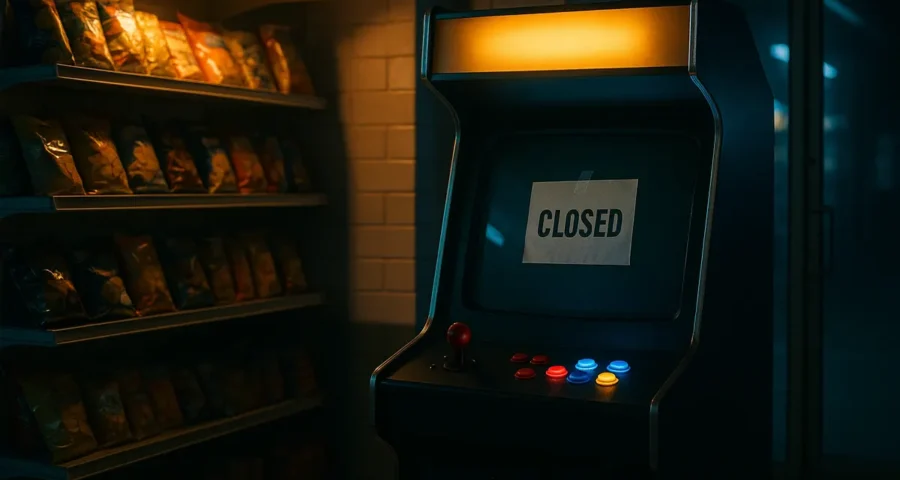
Is a machine that asks you to tap the screen at the right moment a slot machine?
Pennsylvania’s Supreme Court decided it is. In June 2026 the court held that an element of skill layered onto a game that is otherwise decided by chance does not exempt the device from the Pennsylvania Gaming Act. That single sentence is the heart of the entire skill games legality fight, and it is why roughly 70,000 cabinets sitting in bars, bodegas, grocery stores and social clubs across the commonwealth are now classed as illegal slot machines unless they sit inside a venue licensed by the Pennsylvania Gaming Control Board.
The problem is not that nobody knows the law. The problem is that “skill” and “chance” are legal categories, not engineering ones, and the people building these machines have spent two decades designing around the gap between the two.
Pennsylvania’s skill game crackdown: what actually happened
The court’s ruling of 15 June 2026 came with a 120-day stay, which expires on 13 October 2026. That stay is the only thing that has kept the machines switched on since the summer.
Earlier in September, the Pennsylvania State Police reminded businesses that the deadline is not satisfied by unplugging a cabinet. The machines have to be physically removed from the premises. On 29 September, Attorney General Dave Sunday repeated the warning in blunter terms: businesses that miss the date risk law enforcement action, which may include seizing and forfeiting the machines, the associated equipment and the money connected to their operation, plus criminal charges where prosecutors think they are warranted.
Sunday’s own framing was that his office would rather not run searches and seizures at storefronts, bars, restaurants and social clubs, and would prefer owners simply comply. Distributors, vendors and manufacturers that refuse to pull their machines out were given the same warning about potential criminal exposure.
Here is the part that should worry any operator watching from another state: the shop owners are the ones holding the liability. One owner of a small Pennsylvania grocery chain told Casino.org his machines were still running and that he had heard nothing from Pace-O-Matic or Miele Manufacturing, the companies behind the Pennsylvania Skill brand, about what to do with the cabinets. A statewide legal reclassification landed on a convenience store manager’s desk with no instructions attached.
Lawmakers in Harrisburg on both sides of the aisle have said they are open to building a legal framework for these games. The industry has asked to be taxed and regulated, though at a rate well below the roughly 54% Pennsylvania casinos pay on slot revenue. With no bill out of committee before the deadline, the court ruling takes effect first and the legislature catches up later, if it catches up at all.
How regulators distinguish skill games from gambling machines
Short answer: by asking how much of the outcome the player actually controls, and then applying one of three legal tests to that answer. Which test a jurisdiction uses matters enormously, because the same machine can pass one and fail another.
Every gambling statute in the US rests on some version of the same three-part definition: consideration (you pay to play), prize (you can win something of value) and chance (the outcome is not within your control). Consideration and prize are easy to prove on a skill game cabinet. All of the litigation lives in the third element.
| Legal test | Question it asks | Effect on skill games |
|---|---|---|
| Predominance (dominant factor) test | Does chance or skill mainly determine the outcome over repeated play? | Most common standard; skill games must show skill outweighs chance |
| Material element test | Is chance a meaningful contributor to the outcome, even if not the main one? | Much harder to pass; a genuine chance component is usually fatal |
| Any chance test | Is there any element of chance at all? | Strictest reading; almost no commercial amusement game survives it |
The predominance test explained
The predominance test, sometimes called the dominant factor test, asks a comparative question: across repeated play, does skill or chance decide who wins? Courts applying it typically look at whether a reasonably practised player can meaningfully improve results, whether the skill element exists before or after the outcome is set, and whether an unskilled player and an expert end up in materially different positions.
That last point is where most skill game designs come apart. If the machine determines the result internally and then asks the player to perform a small task to collect it, the task is not changing the outcome. It is a collection step. A player who performs it perfectly every time still faces the same long-run return as everyone else, because the return is fixed by the game’s math, not by reflexes. The distinction between influencing a result and unlocking a result already decided is the single most useful lens for assessing any cabinet.
Material element of chance vs skill
States using the material element doctrine do not weigh skill against chance at all. They ask whether chance plays a material part in the result. If it does, the device is a gambling machine even when skill plays a larger part. Pennsylvania’s Supreme Court reasoned along these lines: a skill component bolted onto a game that is otherwise chance-based does not lift the device out of the Gaming Act.
This is why the industry’s favourite argument, that these are games of skill with a chance component, is legally weaker than it sounds. Under a material element standard, admitting the chance component is admitting the case.
Why unregulated machines ended up in a legal gray area
Skill games spread because they occupied a space nobody was policing. Amusement devices, from pinball to claw machines, have long been treated differently from gambling devices, and in many states the enabling statutes for commercial casinos simply never contemplated a cash-paying terminal in a sandwich shop. That gap, plus an absence of clear case law, gave distributors room to place machines and argue classification later, one prosecution at a time.
The gap also made these machines commercially attractive in a way licensed slots can never be. A regulated slot machine carries an enormous compliance load. An unregulated cabinet carries almost none.
| Oversight area | Licensed slot machine | Skill game cabinet |
|---|---|---|
| Venue restriction | Licensed gaming facility only | Any business willing to host it |
| Regulator | State gaming board (in PA, the PGCB) | None |
| RNG and RTP testing | Independent lab certification required | Not state-certified or published |
| Tax on revenue | 48%–54% on slot revenue in Pennsylvania | No gaming-specific state tax |
| Age and responsible-gambling controls | Mandated and audited | Dependent on the host business |
Be fair about the other side of this. The revenue from these machines genuinely kept small businesses alive through the pandemic and the inflation that followed, which is exactly why Harrisburg keeps flirting with legalisation rather than extinction. Nobody in that debate is arguing that convenience store owners are villains. The question is whether a cash-paying terminal with no RNG certification, no published return to player and no regulator should sit next to the lottery tickets.
What businesses risk when the deadline lands
In Pennsylvania the exposure is concrete and already published: seizure and forfeiture of machines, seizure of associated equipment, forfeiture of the money tied to the machines’ operation, and criminal charges where prosecutors consider them appropriate. Distributors, vendors and manufacturers have been warned they are not insulated by sitting one step back from the premises.
If you operate or host machines anywhere this question is live, a short compliance checklist does more good than another legal opinion:
- Identify which test your state applies. Predominance, material element and any-chance produce different answers from identical hardware.
- Read your contract with the distributor. Who owns the cabinet, who removes it, and who carries the liability if it is seized?
- Treat “powered off” as non-compliance. Pennsylvania’s instruction was physical removal, and other regulators have taken the same line.
- Check your other licences. Liquor, lottery and business permits can all be jeopardised by hosting an illegal gambling device.
- Document the date you removed the machines. Enforcement decisions often turn on whether a business acted before or after a deadline.
Why the skill vs chance line keeps blurring
Because the technology moves faster than the statutes, and because the statutes were written with cabinets in mind rather than code.
Modern cabinets can be configured remotely. A machine inspected in one configuration can behave differently next month. Software can present a puzzle, a memory sequence or a nudge feature whose actual influence on the payout is a question for a lab, not a police officer standing in a shop. Meanwhile the same classification problem has migrated online into sweepstakes models, prediction markets and skill-based tournament apps, all built on the argument that something other than pure chance decides the result.
Courts are being asked to draw a bright line through a design space built specifically to blur it. Pennsylvania drew its line by refusing to let a skill overlay rescue a chance-based game. That is a workable standard, and it is one other states may borrow, but it does not resolve the harder cases where skill genuinely does move the numbers.
The practical takeaway for operators is unglamorous. Classification risk is now a live business risk, not a theoretical one, and the party most likely to lose money when a court rules is the small business hosting the hardware.
Frequently asked questions
What makes a game skill-based in legal terms?
A game is treated as skill-based when the player’s decisions, knowledge or dexterity meaningfully determine the outcome, and a practised player can expect different results from a novice. If the result is set internally and the player only performs an action to collect it, that is not legally skill.
How do regulators distinguish skill from chance?
They apply one of three tests: predominance (does skill outweigh chance?), material element (does chance play a meaningful role at all?), or any chance (is there any chance involved?). The same machine can be legal under one and illegal under another.
Why are skill games controversial?
They compete with licensed slots while paying no gaming tax and submitting to no RNG or return-to-player certification. Licensed operators see unfair competition, tax authorities see lost revenue, and small businesses see income they cannot easily replace.
What happened in Pennsylvania?
The state Supreme Court ruled on 15 June 2026 that skill games are slot machines under the Gaming Act and may only operate in facilities licensed by the Gaming Control Board. A 120-day stay expires on 13 October 2026, after which machines must be physically removed or businesses face seizure, forfeiture and possible criminal charges.
One closing note that applies regardless of how any court rules: these machines take real money, and like any gambling product they carry a built-in house edge, so the venue and the operator profit over time. If play stops being entertainment, deposit and time limits, cool-off periods and self-exclusion tools exist for a reason, and support services are available in every US state.
Leave a Reply